











Focus of Article:
The focus of PART 1 of this article is to analyze Blackstone Secured Lending Fund’s (BXSL) recent results and compare a handful of the company’s metrics to 11 business development company (“BDC”) peers. This analysis will show past and current data with supporting documentation. Table 1 will compare BXSL’s recent net asset value (“NAV”) economic return (loss), adjusted net investment income (“NII”), stock price to annualized NII ratio, and percentage of total investment income attributable to capitalized payment-in-kind (“PIK”)/deferred interest income to the 11 BDC peers. Table 1 will also provide a premium (discount) to estimated CURRENT NAV analysis using stock prices as of 3/6/2026. Table 2 will compare BXSL’s investment portfolio (including several additional metrics) as of 9/30/2025 and 12/31/2025 to the 11 BDC peers.
I am writing this two-part article due to the continued requests that such an analysis be specifically performed on BXSL and some of the company’s BDC peers at periodic intervals. These BDC peers include Ares Capital Corp. (ARCC), Capital Southwest Corp. (CSWC), FS KKR Capital Corp. (FSK), Gladstone Investment Corp. (GAIN), Golub Capital BDC Inc. (GBDC), Main Street Capital Corp. (MAIN), Oaktree Specialty Lending Corp. (OCSL), Blue Owl Capital Corp. (OBDC), SLR Investment Corp. (SLRC), TriplePoint Venture Growth BDC Corp. (TPVG), and Sixth Street Specialty Lending Corp. (TSLX).
Understanding the characteristics of a company’s investment portfolio and operating performance can shed some light on which companies are overvalued or undervalued strictly per a “numbers” analysis. This is not the only data that should be examined to initiate a position within a particular stock/sector. However, I believe this analysis would be a good “starting-point” to begin a discussion on the topic. My Buy, Sell, or Hold recommendation and current price target for BXSL will be in the “Conclusions Drawn” section of the article. This includes providing a list of the BDC stocks I currently believe are undervalued (a buy recommendation), overvalued (a sell recommendation), or appropriately valued (a hold recommendation).
NAV, Economic Return (Loss), Current Premium (Discount) to NAV, and NII Analysis – Overview
Let us start this analysis by getting accustomed to the information provided in Table 1 below. This will be beneficial when explaining how BXSL compares to the company’s 11 BDC peers regarding the metrics stated above. Due to the fact several BDC peers listed in Table 1 have a different fiscal year-end, all quarterly results are based on a calendar year-end. For instance, all metrics below are stated “Q4 2025” even though this does not correspond to every company’s fiscal year-end. Readers should be aware as such when the analysis is presented below.
Table 1a + 1b – NAV, Economic Return (Loss), Current Premium (Discount) to NAV, NII, and Capitalized PIK Analysis
The REIT Forum The REIT Forum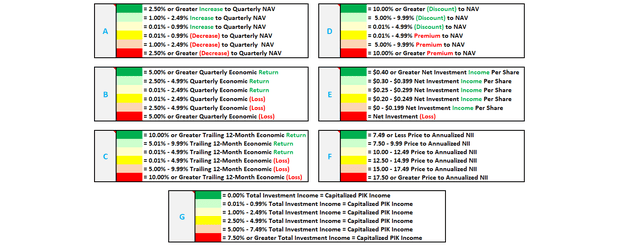
(Source: Table created by me, obtaining historical stock prices from NASDAQ and each company’s NAV per share figures from the SEC’s EDGAR Database.)
Table 1 above provides the following information on BXSL and the 11 BDC peers (see each corresponding column): 1) NAV per share at the end of calendar Q3 2025; 2) NAV per share at the end of calendar Q4 2025; 3) NAV per share change during calendar Q4 2025 (percentage); 4) economic return (loss) (change in NAV and accrued dividend) during calendar Q4 2025 (percentage); 5) economic return (loss) during the trailing 24-months (percentage); 6) my estimated CURRENT NAV per share (NAV as of 3/6/2026); 7) stock price as of 3/6/2026; 8) 3/6/2026 premium (discount) to my estimated CURRENT NAV (percentage); 9) NII (or adjusted NII where applicable) per share during calendar Q4 2025; 10) NII (or adjusted NII where applicable) per share change versus the prior quarter; 11) NII (or adjusted NII where applicable) per share change versus calendar Q4 2024; 12) 3/6/2026 stock price to annualized NII ratio; and 13) percentage of total investment income attributable to capitalized PIK (deferred) interest income during calendar Q4 2025 (percentage).
Now that an overview has been provided, let us start the comparative analysis.
Analysis of BXSL
Using Table 1 above as a reference, BXSL had a NAV of $27.15 per share at the end of calendar Q3 2025. BXSL had a NAV of $26.92 per share at the end of calendar Q4 2025. This calculates to a quarterly NAV decrease of ($0.23) per share or (0.85%). The majority of this minor NAV decrease was directly in relation to net unrealized losses associated with a small portion of portfolio companies during the quarter. This included, but was not limited to, unrealized depreciation within ACI Group Holdings, Inc. (“ACI”), Turing Holdco, Inc. (Turing), and Medallia, Inc. (Medallia). I correctly projected slight – modest unrealized depreciation occurring within several other previously-discussed portfolio companies last quarter. When including BXSL’s quarterly base dividend of $0.77 per share and no special periodic dividend, the company had an economic return (change in NAV and accrued dividends) of $0.54 per share or 1.99% for calendar Q4 2025. It should also be noted BXSL had a trailing 24-month economic return of 24.08%. This percentage was slightly above the covered 12 BDC peer average (a slightly positive catalyst/trend).
BXSL’s performance during the past four quarters was mainly attributable to the following three factors: 1) minor-modest net underpayment of dividends (including special periodic dividends if/when applicable) when compared to the company’s NII/adjusted NII; 2) very minor net realized loss within a couple of exited/ restructured portfolio companies; and 3) modest net unrealized depreciation within the company’s active investment portfolio. This is a good transition to the next topic of discussion, an analysis of BXSL’s investment portfolio (including several additional metrics) as of 9/30/2025 and 12/31/2025. To begin this analysis, Table 2 is provided below.
Tables 2a + 2b – Investment Portfolio Composition Analysis (Including Several Additional Metrics; 12/31/2025 Versus 9/30/2025)
The REIT Forum The REIT Forum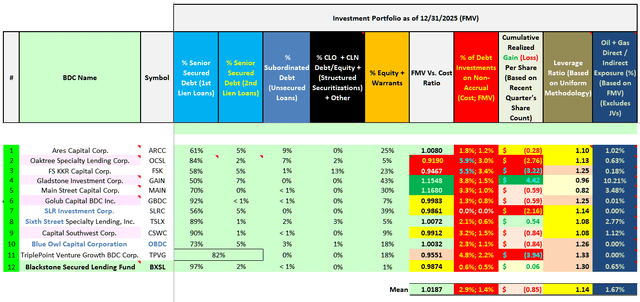
(Source: Tables created by me, directly obtaining some figures/percentages from the SEC’s EDGAR Database [link provided below Table 1]. All remaining figures/percentages were calculated using data obtained within the SEC’s EDGAR Database.)
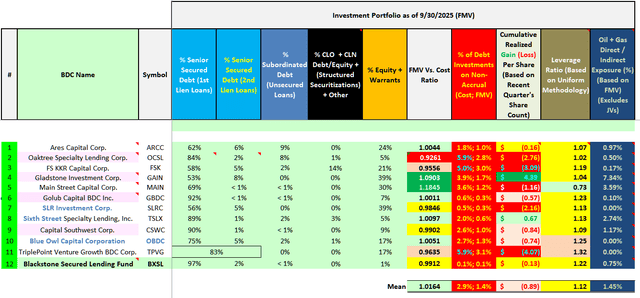
Using Tables 2a and 2b above as a reference, BXSL had 97% and 2% of the company’s investment portfolio in senior secured first- and second-lien loans as of 12/31/2025, respectively. As such, these types of loans comprised the vast majority of BXSL’s investment portfolio. When compared to the prior quarter, BXSL’s percentage of senior secured first- and second-lien loans remained unchanged. BXSL also had less than 1%, 0%, and 1% of the company’s investment portfolio in subordinated debt (unsecured loans), collateralized loan obligations (“CLO”)/credit-linked notes (“CLN”) (structured securitizations) + other, and equity/warrants, respectively. When compared to the prior quarter, BXSL’s percentage of subordinated debt (unsecured loans), CLO/CLN (structured securitizations) + other, and equity/warrants remained unchanged as well. As such, there was not a shift in investment portfolio composition during calendar Q4 2025.
I would also point out BXSL’s proportion of second-lien loans and subordinated debt is very low when compared to the company’s 11 BDC peers. Simply put, this is generally a positive characteristic regarding potential credit risk/recoveries in a recessionary environment (consider general credit hierarchy). I believe BXSL’s below average non-accrual percentages are direct evidence of the company’s more cautionary strategy regarding capital stack/credit hierarchy.
As of 12/31/2025, BXSL’s investment portfolio had a “fair market value (“FMV”) versus cost” ratio of 0.9874x. When compared to the 11 other BDC peers within this analysis, this ratio was slightly below the mean of 1.0187x (a minor negative factor/trend). However, I would point out MAIN’s and GAIN’s FMV versus cost ratio of 1.1680 and 1.1548 as of 12/31/2025, respectively, “skews” the metric to the upside a bit. When compared to a ratio of 0.9912x as of 9/30/2025, BXSL’s ratio very slightly decreased during calendar Q4 2025. As noted above, this was mainly the result of unrealized depreciation in several BXSL’s portfolio companies. A more detailed “breakdown” of BXSL’s quarterly performance was recently provided to our Investing Group subscribers via a quarterly earnings assessment article.
BXSL had only 0.6% and 0.5% of the company’s investment portfolio on “non-accrual” status as of 12/31/2025; based on its amortized cost basis and FMV, respectively. When compared to the 11 BDC peers as of 12/31/2025, BXSL’s amortized cost and FMV non-accrual percentage were modestly below the mean of 2.9% and 1.4%, respectively (a positive catalyst/trend).
Since the company’s initial public offering (“IPO”) in 2021, BXSL’s investment portfolio as of 12/31/2025 has generated a cumulative realized gain of $0.06 per share (when based on a per share count as of 12/31/2025). BXSL’s cumulative realized gain figure was modestly more attractive when compared to the mean loss of ($0.85) per share (a positive catalyst/trend). This includes GAIN’s cumulative realized gain of $4.42 per share which skews this figure to the upside (would be a larger net loss when excluding GAIN). I believe calculating a BDC’s cumulative realized gain (loss) per share amount provides an extremely useful metric when analyzing the long-term performance of management’s underwriting abilities, due diligence, expertise, and operational performance. This metric provides direct evidence BXSL’s management team has, regarding a majority of instances, continued to find attractive debt/equity investments over a long period of time which, more times than not, have ultimately delivered attractive risk-adjusted returns.
As of 12/31/2025, 0.65% of BXSL’s portfolio had debt and equity investments within the oil and gas sector (based on FMV; including certain investments in the energy sector which had “oil and gas” characteristics and/or services closely linked to the sector). When compared to the 11 other BDC peers within this analysis, BXSL’s oil and gas exposure was slightly below the mean of 1.67%. When compared to the prior quarter, BXSL’s exposure to the oil and gas sector fractionally decreased. Even though larger oil and gas companies benefited during most of 2022 from a net increase to commodity prices tied to inflation and the ongoing Russia/Ukraine conflict, I would point out most sector prices largely retraced during late 2022 – 2025.
However, with the recent conflict in the Middle East, oil and gas prices have sharply increased over the prior week+ (largest increase in years). Depending on how long this regional conflict lasts, there will very likely continue to be volatility in pricing (both to the upside and downside as the conflict evolves/winds down). This could temporarily benefit U.S. oil and gas companies. Simply put, dependent upon offsetting/mitigating hedges/forward contracts, smaller/private oil and gas companies could benefit from this recent conflict regarding increased domestic oil and gas production (which would trickle down to several parts of the economy).
This could be a short- or long-term event dependent upon many unresolved geopolitical/macroeconomic variables. As such, I would remain a bit cautious considering the ramifications of this specific sector regarding high-yield/speculative-grade credit. That said, on the flip side, sharply higher oil and gas prices will have a direct impact on various facets of the U.S. economy which could lead to a rise in credit risk outside the oil and gas sector down-the-road. As is the case in most scenarios, there is usually a “give and take.”
Once again using Table 1 as a reference, BXSL reported adjusted NII (which excludes capital gains incentive fees) of $0.803 per share during calendar Q4 2025. I prefer to track/utilize BXSL’s adjusted NII metric as opposed to NII (more indicative of net investment company taxable income [ICTI]). When comparing each company’s stock price as of 3/6/2026 to its annualized NII (or where applicable adjusted NII), BXSL had the 4th lowest ratio at 7.41x. BXSL’s annualized adjusted NII ratio was slightly – modestly below the 12-peer ratio of 8.97x as of 3/6/2026 (a positive catalyst/trend). Historically speaking, BXSL’s price-to-earnings ratio as of 3/6/2026 was very attractive/low (a positive catalyst/trend).
During calendar Q4 2025, 7.74% of BXSL’s total investment income was attributable to capitalized PIK/deferred interest income. When compared to the 11 other BDC peers within this analysis, this was basically at the mean of 7.75% (a neutral catalyst/trend). I believe it is never a positive catalyst/trend when a BDC has any portion of its accrued income classified as being capitalized/deferred. Simply put, under GAAP, capitalized PIK interest/dividend income is revenue that is currently being “booked” but has not actually been received in cash yet (deferred). In a majority of cases, capitalized PIK interest income is paid in cash at the maturity of that particular loan/when a sale occurs. However, in my experience, more times than not capitalized PIK interest income is a contractual amendment regarding a specific portfolio company who is, at the time, having operational difficulties (which increases the probably of the eventual inability of paying its loan obligations). This especially holds true when a specific debt investment had no capitalized PIK feature at the origination of a particular loan but is currently accruing 100% capitalized PIK interest income due to a loan modification/restructuring.
Simply put, in a majority of cases, it is a “slick” strategy of continuing to record accrued interest income only to write-off this capitalized interest income at a later date; usually at loan maturity by classifying that “lost deferred interest” as a reduction in the debt investment’s proceeds (a realized loss) as opposed to lowering previously accrued income by the accumulated capitalized PIK balance. I am not stating this occurs all the time but certain BDC peers tend to utilize this “phantom income” strategy regularly. In particular, Prospect Capital Corp. (PSEC) has been prone to this strategy to a greater degree over the years versus all the other BDC peers within this analysis which was pointed out for years (and one of the reasons I dropped that BDC back in 2024). As such, it could be the case capitalized PIK interest income is never “completely” received in cash upon maturity/when a sale occurs. In my professional opinion, if a BDC has a large/above average portion of its investment income classified/accrued as capitalized PIK interest income, it should be seen as a potential concern regarding future performance/credit quality. In the end, one really just has to go “case-by-case” to determine the overall “viability” of a BDC actually eventually receiving this capitalized PIK/deferred interest income in the future. Something I continually monitor/track in my modeling.
A great recent example of this trend was FSK. This particular BDC peer has been carrying high – very high capitalized PIK/deferred interest income for quite some time. I previously continued to warn subscribers/readers about this negative factor/trend for a handful of quarters. I also warned of “looming” non-accruals within FSK’s investment portfolio. During Q2 2025 and Q4 2025, FSK placed 4 and 5 new portfolio companies on non-accrual status, respectively. During Q2 2025, this included 3 very large portfolio companies that previously had PIK provisions. Simply put, this was not a surprise to me/my team but appeared to be quite a surprise for market participants. As a direct result, FSK’s stock price fairly recently notably dropped (I/we had FSK listed as notably overvalued/Strong Sell prior to the company’s Q2 2025 earnings).
As of 3/6/2026, BXSL’s stock price traded at $23.82 per share. When calculated, BXSL’s stock price was trading at a discount to my estimated CURRENT NAV (NAV as of 3/6/2026; $26.65 per share) of ($2.83) per share or (10.62%). This was slightly more attractive than the 12-BDC covered peer average of a discount of (7.42%) (a slightly positive catalyst/trend). I continue to believe BXSL should trade at a modest – notable premium to the company’s CURRENT NAV. As such, based on my proven valuation methodology over various interest rate/economic cycles, I currently believe BXSL is one of several BDC sector peers that is notably undervalued.
Comparison of BXSL’s NAV, Economic Return, Valuation, NII, and Other Metrics to 11 BDC Peers in Ranking Order
The REIT Forum Feature
Conclusions Drawn (PART 1):
PART 1 of this article has analyzed BXSL and 11 other BDC peers in regards to the following metrics: 1) trailing 24-month economic return (loss) (good indicator of recent overall performance); 2) percentage of investments on non-accrual status as of 12/31/2025 (good indicator of overall portfolio health/credit risk); 3) cumulative gain (loss) per share as of 12/31/2025 (great indicator of long-term performance); 4) current premium (discount) to my estimated CURRENT NAV per share (NAV as of 3/6/2026) (very good indicator of overall valuation); 5) current stock price to annualized NII ratio (good indicator of overall valuation); and 6) percentage of total investment income attributable to capitalized PIK (deferred) interest income (good indicator of overall portfolio health/credit risk).
When compared to the 11 other BDC peers within this analysis, I believe BXSL continues to outperform a majority of the company’s BDC peers I currently cover. This includes, but is not limited to, BXSL’s attractive adjusted NII per share (though, to remain unbiased, has net decreased over the prior several quarters [similar to most sector peers]), a modestly below average percentage of investments on non-accrual status as of 12/31/2025, a modestly more attractive cumulative realized gain (loss) per share amount as of 12/31/2025, a very low exposure to the oil and gas sector (including certain investments in the energy sector which had oil and gas characteristics and/or services closely linked to the sector), a slightly above average trailing 24-month economic return percentage, and a slightly more attractive stock price to annualized adjusted NII ratio (all positive catalysts/trends). In addition, BXSL is tied as having the lowest management fees out of the externally-managed covered BDC peers at 1.00% of total assets less cash and cash equivalents. Simply put, this will continue to positively impact shareholders via lower proportionate fees versus most other externally-managed BDC covered peers.
That said, to remain non-bias, this article also highlighted BXSL had a slightly below average FMV versus cost ratio and an average capitalized PIK/deferred interest income percentage (slightly negative – cautious factors/trends).
Looking back, I previously correctly identified the very high probability of an increasing BXSL base dividend and/or special periodic dividends during 2022 – 2023. This was mainly due to the U.S. London Interbank Offered Rate (LIBOR)/Standard Overnight Financing Rate (“SOFR”)/PRIME very quickly moving past all floors on the asset side of the balance sheet, along with financing outstanding borrowings with longer-term, lower cost debt on the liability side of the balance sheet, during 2021.
That said, to remain non-bias, during 2024 – 2026 one had/has to continue to monitor the weighted average annualized yield on new loan originations versus exiting debt investments as there remains a pretty good “lag” in this specific metric. Something I continually track. In addition, I believe the majority of sector earnings peaked during late 2023 – early 2024 (previously “plateaued”). The rapid NII growth that sector peers experienced during 2022 – 2023 simply did not occur during 2024 – 2025 (nor will occur during 2026 – 2027). As the FOMC began to reduce the Federal Funds Rate (started in September 2024), sector earnings will GRADUALLY decrease over time. The severity of decreases will vary peer-to-peer (which I continuously project/model). This notion is already embedded in all price targets. Furthermore, credit risk will almost certainly rise (albeit mildly) throughout the sector during 2026 but should begin to slowly ease in 2027.
However, I continue to believe BXSL is better positioned to weather a potential minor – modest recession when compared to most sector peers (as highlighted in the analysis above).
Dividend sustainability will be discussed/analyzed in PART 2 of this sector comparative analysis.
My Buy, Sell, or Hold Recommendation:
From the analysis provided above, including additional factors not discussed within this article (additional metrics covered in PART 2), I currently rate BXSL as a Sell when I believe the company’s stock price is trading at or greater than a 22.5% premium to my projected CURRENT NAV (NAV as of 3/6/2026; $26.65 per share), a HOLD when trading at less than a 22.5% premium but greater than a 12.5% premium to my projected CURRENT NAV, and a Buy when trading at or less than a 12.5% premium to my projected CURRENT NAV.
Therefore, with a closing price as of 3/9/2026 of $24.08 per share, I currently rate BXSL as NOTABLY UNDERVALUED from a stock price perspective.
As such, I currently believe BXSL is a Strong Buy recommendation
My current price target for BXSL is approximately $32.65 per share. This is currently the price where my recommendation would change to a Sell. The current price where my Strong Buy recommendation would change to a Hold is approximately $30.00 per share. Put another way, the following are my CURRENT Buy, Sell, or Hold per share recommendation ranges for BXSL (our Investing Group subscribers get this type of data on all 12 BDC (and 18 mortgage real estate investment trust [mREIT) stocks I currently cover on a weekly basis):
$32.65 per share or above = SELL (Overvalued)
$30.01 – $32.64 per share = HOLD (Appropriately Valued)
$27.81 – $30.00 per share = BUY (Undervalued)
$27.30 per share or below = STRONG BUY (Notably Undervalued)
BDC Sector Recommendations as of 3/6/2026:
Table 10 – Past and Current BDC Recommendations
The REIT Forum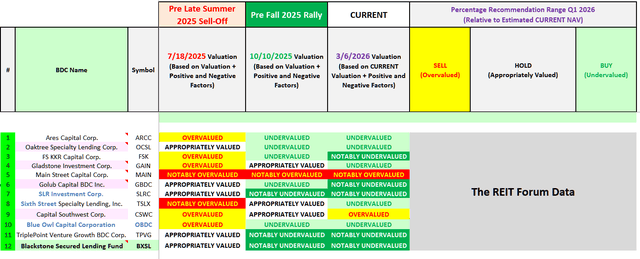
(Source: Table created by me, including all past and present recommendations based on data obtained from the SEC’s EDGAR Database [link provided below Table 1a])
Table 10 above provides the following information on BXSL and the 11 BDC peers (see each corresponding column): 1) 7/18/2025 Buy, Sell, or Hold recommendation (pre late summer 2025 sell-off); 2) 10/10/2025 Buy, Sell, or Hold recommendation (pre fall 2025 rally); and 3) 3/6/2026 Buy, Sell, or Hold recommendation range, relative to my estimated CURRENT NAV.
I currently have 5 BDCs rated as NOTABLY UNDERVALUED (Strong Buy), 5 rated as UNDERVALUED (Buy), 0 rated as APPROPRIATELY VALUED (Hold), 1 rated as OVERVALUED (Sell), and 1 as NOTABLY OVERVALUED (Strong Sell). Simply put, certainly not as bearish as late 2019 – early 2020 or the June – July 2025. I currently believe the sector, as a whole, is slightly – modestly undervalued. I would just be mindful knowing high-yield/speculative-grade credit spreads directly impact broader asset valuations. I continue to project a net widening of spreads during 2026 – early 2027. This is something I have continued to discuss with subscribers. Important to understand.
That said, I continue to see great value with BXSL (yes, even considering a projected dividend reduction at some point during 2026; discussed in PART 2).
The analysis performed above does not provide “every” catalyst/factor to consider when choosing a BDC investment. However, I believe this analysis is a good starting point to begin a discussion on the topic. Additional metrics will be analyzed in PART 2 of this article. PART 2 will take a look at BXSL’s past and current dividend rates, yields, and other similar metrics and compare the results to the 11 other BDC peers. Several of these metrics have a direct impact on future operations/results as events unfold. This includes dividend projections for all 12 peers for calendar Q2 2026/each applicable company’s next set of dividend projections.
My Personal BXSL Past + Current Stock Disclosures
The following are my BXSL past and current stock disclosures and total returns since I have been writing on Seeking Alpha (since 2013):
Table 11 – BXSL Past + Current Stock Disclosures/Returns
The REIT Forum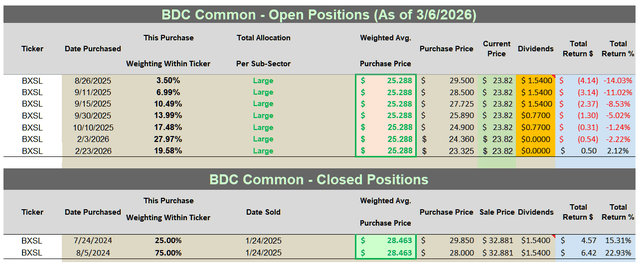
Source: Taken Directly from the REIT Forum’s © Spreadsheets/Data.
Final Note: All trades/investments I have performed over the past 10 years have been disclosed to readers in “real time” (that day at the latest) via Seeking Alpha and, more recently, the “live chat” feature of our Investing Group (which cannot be changed/altered). Beginning in January 2020, I transitioned all my real-time purchase and sale disclosures solely to subscribers of the REIT Forum. All applicable public articles will still have my “main ticker” purchase and sale disclosures (just not real-time alerts). At the end of February 2026, I had an unrealized/realized gain “success rate” of 88.5% and a total return (includes dividends received) success rate of 95.4% out of 87 total past and present mREIT and BDC positions (updated monthly; multiple purchases/sales in one stock count as one overall position until fully closed out). I encourage other Seeking Alpha contributors to provide real time buy and sell updates for their readers/subscribers which would ultimately lead to greater transparency/credibility.
Simply put, a contributor’s/team’s recommendation track record should “count for something” and should always be considered when it comes to credibility/successful investing.
Understanding My/Our Valuation Methodology Regarding mREIT Common and BDC Stocks:
The basic “premise” around my/our recommendations in the mREIT common and BDC sectors is value. Regarding operational performance over the long-term, there are above average, average, and below average mREIT and BDC stocks. That said, better-performing mREIT and BDC peers can be expensive to own, as well as being cheap. Just because a well-performing stock outperforms the company’s sector peers over the long-term, this does not mean this stock should be owned at any price. As with any stock, there is a price range where the valuation is cheap, a price where the valuation is expensive, and a price where the valuation is appropriate. The same holds true with all mREIT common and BDC peers. As such, regarding my/our investing methodology, each mREIT common and BDC peer has their own unique Buy, Sell, or Hold recommendation range (relative to estimated CURRENT BV/NAV). The better-performing mREITs and BDCs typically have a recommendation range at a premium to BV/NAV (varying percentages based on overall outperformance) and vice versa with the average/underperforming mREITs and BDCs (typically at a discount to estimated CURRENT BV/NAV).
Each company’s recommendation range is “pegged” to estimated CURRENT BV/NAV because this way subscribers/readers can track when each mREIT and BDC peer moves within the assigned recommendation ranges (daily if desired). That said, the underlying reasoning why I place each mREIT and BDC recommendation range at a different premium or (discount) to estimated CURRENT BV/NAV is based on roughly 15-20 catalysts which include both macroeconomic catalysts/factors and company-specific catalysts/factors (both positive and negative). This investing strategy is not for all market participants. For instance, not likely a “good fit” for extremely passive investors. For example, investors holding a position in a particular stock, no matter the price, for say a period of 5+ years. However, as shown throughout my articles written here at Seeking Alpha since 2013, in the vast majority of instances I have been able to enhance my personal total returns and/or minimize my personal total losses from specifically implementing this particular investing valuation methodology. I hope this provides some added clarity/understanding for new subscribers/readers regarding my valuation methodology utilized in the mREIT common and BDC sectors.
Each investor’s Buy, Sell, or Hold decision is based on one’s risk tolerance, time horizon, and dividend income goals. My personal recommendation will not fit each reader’s current investing strategy. The factual information provided within this article is intended to help assist readers when it comes to investing strategies/decisions. Please disregard any minor “cosmetic” typos if/when applicable.


