






Dear Fellow Investor,
Upslope’s objective is to deliver attractive, equity-like returns with significantly reduced market risk and low correlation versus traditional equity strategies. Historically, Upslope has performed well during periods of volatility and struggled during speculative manias. Q2 resembled the latter and was very difficult. What made it unusual was the combination of strong market returns and weak returns across Upslope’s long portfolio, as investors broadly avoided boring, cash-flowing, non-AI stocks.
Upslope Exposure & Returns1 Benchmark Returns
Note: LPs/clients should always check individual statements for returns, which may vary due to timing, fee schedules and other factors. Since inception returns, downside standard deviation, and Sortino are all annualized figures.
Market conditions – ‘buy good companies. Don’t overpay. Do nothing.’
The above is the legendary investment mantra of Fundsmith, a UK-based fund manager. I’ve had it taped to my wall – with a handful of other North Star-like quotes – for years. It’s deceptively simple: easy to understand, difficult to execute. At least one of the three pillars is always difficult to follow. It’s remarkably easy to convince oneself that a cheap company is “good” or that a high-quality company is “cheap.” Markets are mostly efficient and high-quality companies rarely trade at attractive valuations.
But in a market maniacally obsessed with momentum, “good companies” get sold due to temporary setbacks or extrapolated risks (enemies of pure momentum). Distinguishing these from permanent impairments has created more opportunities than usual to “buy good companies” without “overpaying.” The catch is that for these investments to work, one must stick to the “do nothing” pillar. This is much harder than usual. Even Fundsmith’s CIO lamented the challenges in his recent letter , citing the business risks of outflows as justification for heightened activity. Ironically, this helps explain why many quality businesses trade at reasonable prices: investors have been selling for reasons unrelated to long-term fundamentals.
Most of Upslope’s longs are cheap, defensive, and executing well (e.g. Crown, Henry Schein). Several have seen rising earnings estimates and falling relative and absolute valuations (e.g. Steris, CME Group). I won’t argue these are the highest quality businesses on the planet. They are not. But they are “good” businesses with obvious moats, and they generally outgrow GDP. With that in mind, it’s no surprise Q2 saw fewer portfolio changes than usual. The only meaningful addition to the long portfolio was, ironically, a company Fundsmith exited during the quarter (Magnum Ice Cream Co). As always, more details follow.
Portfolio Positioning
As of this writing, gross and beta-adjusted net exposures were 155% and 38%, respectively. Positioning reflects a high number of perceived opportunities on both the long and short sides of the portfolio. Gross is elevated above the Fund’s typical 150% ceiling due to certain directly hedged positions.
Exhibit 1: Portfolio Snapshot
Note: as of 7/16/26 and may change without notice. Positions disclosed/categorized at Upslope’s discretion. Tickers shown for underlying businesses; actual securities/instruments held may differ. Source: Upslope, FactSet
Exhibit 2: Gross Exposure by Market Cap & Geography (Total Portfolio)
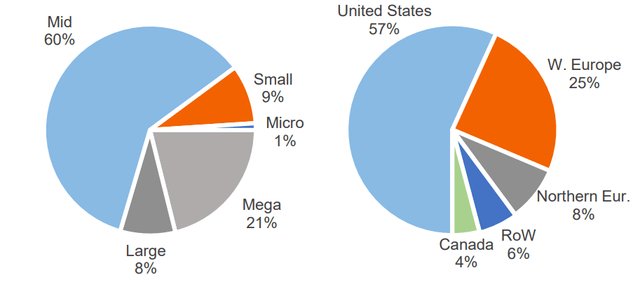
Note: as of 7/16/26. Market cap ranges: Micro (<$500mm), Small ($500mm – $2bn), Mid ($2bn – $25bn), Large ($25bn – $50bn), Mega (>$50bn). Source: Upslope, Interactive Brokers, FactSet
Portfolio Updates
The largest individual contributors to and detractors from quarterly performance are noted below. Gross contribution to overall portfolio return is noted in parentheses.
Exhibit 3: Top Contributors to Quarterly Performance (Gross)
Source: Upslope, Opus Fund Services, Interactive Brokers
Note: Amounts may not tie due to rounding. Total net performance during above period: -6.6%.
Key Exits
The Fund finished exiting Intel (INTC, semiconductor designer and manufacturer) and Hershey (HSY, North American candy and salty snack business) due to full valuations and theses having played out.
The Fund also exited Jack Henry (JKHY, fintech business focused on core processing and payments for regional banks). This was disappointing, as the exit was largely due to risk management. Fundamentals remained solid, but shares were hit hard by AI worries. “Proving” the market wrong about these worries will simply take time (a lot of it) and, possibly, additional valuation compression. JKHY was not the only holding with this perceived risk and exiting was aimed at reducing broader exposure to a manageable level.
New Long – Magnum Ice Cream (MICC)
Magnum is a pure-play global ice cream company spun out of Unilever at the end of 2025. It is by far the largest ice cream company in the world (~21% share) with almost double the market share of the #2 player, Froneri (private). Beyond Magnum and Froneri, the largest players hold 2% share at most. Magnum and Froneri are rare for their exclusive focus on ice cream. Key brands owned by Magnum include Ben & Jerry’s, Breyer’s, Cornetto, Wall’s, and of course the flagship Magnum brand. Geographically, Magnum’s sales are balanced by region, with nearly 40% each in the Americas and Europe/ANZ, and 25% in Asia, Middle East, and Africa. Emerging Markets are a key growth driver, contributing ~30% of sales.
Magnum initially came on to Upslope’s radar as I reviewed out-of-favor consumer staples businesses but sought those with manageable GLP-1 risks due to lower U.S. sales concentration (Magnum is ~25% U.S.). Upslope’s key thesis points for Magnum include the following:
(1) Dominant, defensive business with significant competitive advantages stemming from ownership of leading global brands (4 of top 5) and complex global frozen supply chain network.
(2) Opportunity for top-line growth acceleration and efficiency (margin) gains as an independently run business now focused exclusively on ice cream and related products.
(3) The Froneri “comp”: represents both margin and valuation upside potential. Froneri has reportedly expanded EBITDA margins to ~20% in recent years vs. ~16% at MICC. There are no obvious reasons why MICC can’t catch-up on margins over time – particularly as a focused standalone business. Further, Froneri’s private equity owner (co-owned with Nestle) recently completed a transaction valuing Froneri for an estimated 10-11x EBITDA 4 . While MICC shares have re-rated in recent weeks, they still trade at a discount. Part of the recent re-rating has been due to rumors in the press about private equity interest in Magnum, despite tax hurdles (due to recent spin-off) making a near-term transaction unlikely.
(4) Attractive valuation and balance sheet: currently trades for ~9.5x 2026E EBITDA (17x EPS) with net leverage <2.5x EBITDA. All figures remain highly reasonable for a leading consumer staples business.
Key risks for the company and shares include: limited history as a standalone public company, GLP-1-related volume and/or consumer trends uncertainty, FX (sales are mostly ex-U.S.), and weather impact on short-term results.
Closing Thoughts
It’s impossible to predict the short term, but I suspect that by year-end we’ll look back on this stretch as an echo of the 2021 mania – different in many ways, but similar in its indiscriminate abandonment of “boring” stocks in favor of more speculative fare.
During periods like these, I am particularly thankful for the support of Upslope’s unique and highly aligned investor base, which has enabled me to operate with a clear head and remain true to Upslope’s nearly decade-old strategy. Thank you, as always, for the trust you’ve placed in me. Please contact me if you have any questions, would like to add to your investment, or know a qualified investor who may be a good fit for Upslope’s approach.
Sincerely,
George K. Livadas
1 See important performance-related details and disclosures in Appendix A.
2 Beta-/delta-adjusted.
3 Calculated as: (Net return since inception – 2.0% risk-free rate) / downside deviation.
4 Source: Barclay’s October 14, 2025 report.
Appendix A: Upslope Capital Long/Short Strategy Performance (net)
Source: Upslope, Interactive Brokers, Opus Fund Services, LICCAR, FactSet, Sentieo, Morningstar. Notes and disclosures: Returns from inception to May 2023 shown for composite of all separate accounts invested according to Upslope’s core long/short strategy. Returns from June 2023 onward shown for Class A interest in Upslope Partners Fund, LP. Performance for a composite of all accounts managed by Upslope from inception is available upon request. Performance for S&P Midcap 400 represented by total return for related exchange-traded fund (ticker: MDY). Individual investment performance may vary. Investors should always review statements for actual results. Data from inception (August 29, 2016) to June 24, 2017 based on portfolio manager’s (“PM”) performance managing the strategy under a prior firm (as sole PM). Thereafter, PM managed the strategy/accounts on a no-fee basis through August 11, 2017, after which Upslope became operational. PAST PERFORMANCE IS NO GUARANTEE OF FUTURE RESULTS.
Appendix B: Portfolio Company (Long) Descriptions 5
CME Group (CME): Leading operator of global derivatives exchanges; focused on rates, commodities, equities and FX. Attractive, durable business that should continue to benefit from global macro volatility. Competitive threat from upstart exchange continues to dissipate.
Crown Holdings (CCK): One of the leading global aluminum beverage can producers, with strong geographic diversification. Decade-low leverage and EV multiples provide an attractive entry point for a company operating well in an out of favor staples-like sector.
Diploma (DPLM-LON): U.K.-based specialty distributor focused on essential consumable products across life sciences, seals (machinery), and controls (aerospace wiring/harnesses). Unique model and conservative M&A strategy have historically enabled attractive free cash flow growth through the cycle.
FTI Consulting (FCN): Boutique consulting and advisory firm, with deep experience in restructuring, dispute/conflict advisory, and other practices. Challenges in a non-core segment have depressed expectations for shares despite an environment that should ultimately lead to strong and rising demand.
Henry Schein (HSIC): Largest national distributor of dental products, as well as general healthcare supplies. Recent investment from KKR, along with long-time CEO transition, appears likely to accelerate efficiency improvements and revenue growth, while maintaining take-private optionality.
Kesko (KESKOB-FI): Uniquely diversified business spanning grocery, building products and auto dealers. Large, defensive grocery business (#2 share in consolidated Finnish market) enables management to allocate capital more aggressively during regional cyclical downturn in building products, as some competitors retrench.
Lifco (LIFCO.B-SE): Storied serial acquiror that has de-rated in the face of various European macro headwinds. Valuation has become reasonable considering the company’s track record of solid organic growth, supplemented by consistent and disciplined acquisition growth funded via strong free cash flow.
Magnum Ice Cream Co (MICC): Recently spun out of Unilever, Magnum is the largest pure-play global ice cream company. New standalone focus creates opportunity to accelerate growth and expand margins in a defensive sector that’s deeply out of favor in public markets.
MarketAxess (MKTX): Challenged member of fixed income/credit “exchange” duopoly. Given macro/geopolitical backdrop and depressed valuation, company appears likely to stabilize market share (or better) in the near-term and/or be acquired by a large exchange in the medium-term.
Smiths Group (SMIN-LON): Historically sleepy UK-based industrial conglomerate focused on specialty industrial niches and, previously, security/detection. Activist pressure led management to transform the business by shedding non-core units and focusing on the strongest legacy segments while aggressively returning capital.
STERIS (STE): Leader in infection prevention, sterilization, and procedural solutions for healthcare providers, hospitals, pharmaceutical & bioprocess customers, and medical-device makers. Strong historic organic growth, despite majority of sales from recurring services and consumables.
Teledyne Tech. (TDY): Producer of specialty electronics, components, and technologies – primarily focused on imaging sensors and cameras. Dinged by transformative 2021 FLIR acquisition, expectations and valuation reset, balance sheet is clean, and the company is positively exposed to rising defense spending, reshoring and physical AI.
5 “Starter” long positions not shown.
Appendix C: Terminology
Core Longs: Higher “quality” businesses (defined as low cyclical, clean balance sheet, obvious and durable competitive advantages) managed with less valuation sensitivity (i.e. typically won’t exit a Core long solely because of valuation) and assuming a multi-year time horizon.
Tactical Longs: Traditional “value” investments of more modest quality (reasonably or very cyclical, currently experiencing operational, competitive or financial challenges) managed with greater valuation sensitivity (i.e. typically begin to exit if shares approach full valuation) and assuming a shorter time horizon (typically 6-18 months).
Starter Longs: Generally smaller, undisclosed longs that fall into at least one of the following groups:
- 1. Ideas where I’ve completed enough work to establish a toehold, but still have more to do.
- 2. Companies facing obvious short-term challenges where I believe the near-term path in shares is likely lower, but the stock is ‘cheap enough’ and outright attractive over the longer-term.
- 3. ‘Counter-shorts’ – higher-beta longs with good risk/reward that trade more in-sync with Upslope’s shorts on a daily basis and can be used to manage overall net long exposure more effectively and tax-efficiently.
Alpha Shorts: Individual company short positions.
Hedges: Diversified index hedges (either long or short).
Original Post
Editor’s Note: The summary bullets for this article were chosen by Seeking Alpha editors.