




Close Menu
The Business TimesThe Business Times
  • Home
  • News
  • Business
  • Finance
  • Economy
  • Markets
  • Investing
  • Real Estate
  • Crypto
  • Fintech
  • Forex
  • More
    • Politics
    • Web Stories
    • Spotlight
    • Press Release
What's On
UK areas with safest homes as interactive map shows residential places most at risk of break-ins

UK areas with safest homes as interactive map shows residential places most at risk of break-ins

13 July 2026
Mortage rates drop but Middle East conflict could see borrowers face more pain

Mortage rates drop but Middle East conflict could see borrowers face more pain

13 July 2026
Fulgent Genetics: Strong Moves By Management Keep Me Bullish (NASDAQ:FLGT)

Fulgent Genetics: Strong Moves By Management Keep Me Bullish (NASDAQ:FLGT)

13 July 2026
Two who died on Seaton Carew beach were dad who drowned trying to save his kids and passer-by

Two who died on Seaton Carew beach were dad who drowned trying to save his kids and passer-by

13 July 2026
‘I’ve no idea if the sun’s up’ with £30 blackout sleep mask ‘great for travel’

‘I’ve no idea if the sun’s up’ with £30 blackout sleep mask ‘great for travel’

13 July 2026
Facebook X (Twitter) Instagram
Business Monday, Jul 13
The Business TimesThe Business Times
Newsletter
  • Home
  • News
  • Business
  • Finance
  • Economy
  • Markets
  • Investing
  • Real Estate
  • Crypto
  • Fintech
  • Forex
  • More
    • Politics
    • Web Stories
    • Spotlight
    • Press Release
The Business TimesThe Business Times
Home » Oakmark Fund U.S. Equity Market Q2 2026 Commentary
News

Oakmark Fund U.S. Equity Market Q2 2026 Commentary

thebusinesstimes.co.ukBy thebusinesstimes.co.uk13 July 20261 Views
Facebook Twitter LinkedIn Reddit Telegram WhatsApp Pinterest Tumblr VKontakte Email
Oakmark Fund U.S. Equity Market Q2 2026 Commentary
Share
Facebook Twitter LinkedIn Pinterest Email

The discipline to stay boring

June 30, 2026

“Investing should be more like watching paint dry or grass grow. If you want excitement, take $800 and go to Las Vegas.” — Paul Samuelson, Nobel Prize winning economist

Before writing these quarterly commentaries, I always reread my most recent editions. Unfortunately, much of what I wrote last quarter still applies ( Why didn’t we do better when value outperformed? ). Through June 30, the Oakmark Fund was flat for the year, trailing double-digit gains for both the S&P 500 and the Russell 1000 Value Index. As in the first quarter, index returns were driven by a sector we didn’t own—a small group of high price-to-earnings (P/E), cyclical technology companies, currently benefiting from increased AI spending. Here is a list of the year-to-date top performers in the Russell 1000 Value Index:

Top 10 Russell 1000 Value Performers

YTD Return

2025 P/E, as of 12/31/25

Sandisk Corporation

SNDK

781%

100x

Micron Technology, Inc.

MU

297%

25x

Intel Corporation

INTC

278%

95x

Dell Technologies, Inc. Class C

DELL

245%

14x

Western Digital Corporation

WDC

241%

28x

Iridium Communications Inc.

IRDM

219%

15x

Marvell Technology, Inc.

MRVL

214%

32x

MSK inc.

MKSI

179%

21x

Flex Ltd.

FLEX

168%

20x

Corning Inc

GLW

153%

37x

Source: FactSet, as of 6/30/2026. Past performance is no guarantee of future results. Chart is for informational purposes only and does not depict the performance of any Harris | Oakmark strategy or product. Returns shown reflect the period during which each security was a constituent of the Russell 1000 Value Index. Following the index reconstitution effective 6/26/2026, certain securities shown above are no longer members of the index. Price-to-earnings ratios represent the average consensus trailing twelve-month (LTM) P/E ratio for each security as of 12/31/2025.

These 10 companies, out of an index containing 863, accounted for nearly half the index’s gain through the first half of 2026. They began the year with a median trailing P/E ratio of 27x, significantly higher than even the S&P 500. By comparison, the Oakmark Fund portfolio, with an estimated 2026 P/E of only 11.7x, looks much more like a traditional value portfolio. That hasn’t helped our recent performance. If you exclude AI-related stocks and the energy companies powering them, the S&P 500 would be down year to date.

An interesting aside: In last month’s Russell Index rebalance, Apple (AAPL) and Microsoft (MSFT) became new members of the Russell 1000 Value Index. As part of that rebalance, Amazon’s (AMZN) Russell value score rose from 27% to 92%. As a result, a significantly larger share of its market capitalization was included in the index, making Amazon the index’s largest holding. Using Russell’s own classification of whether a stock is value or growth shows just how much the market has changed. For most of the past 25 years, stocks Russell deemed value comprised the overwhelming majority of the Russell 1000 Value Index. Today, the majority is growth. The extraordinary increase in AI infrastructure spending is pushing all but the “growthiest” growth companies into the Russell Value Index.
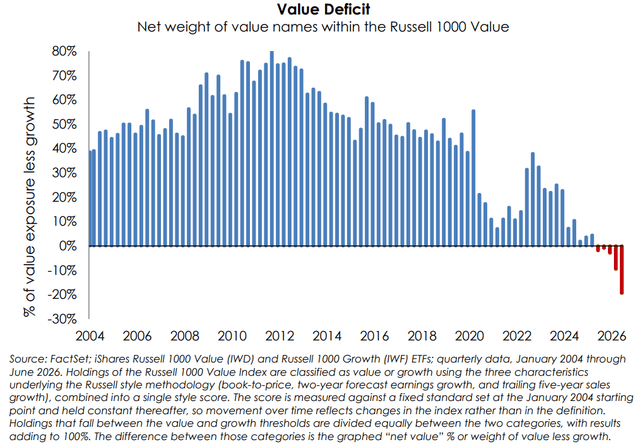
Value deficit

Given the obvious parallels between today’s AI-driven market and the Internet market 27 years ago, we are increasingly asked whether we expect a repeat of the dot-com bust. Anyone answering that with certainty is suffering from overconfidence. There are clear similarities: a once-in-a-generation technological advance, extraordinary gains concentrated in a narrow part of the market, newly minted fortunes and widespread concern about how the new technology may reshape the economy. Perhaps just as important is the similarity in investor behavior.

In more typical markets, conversations with clients and prospective clients focus on the companies we’ve purchased. Today, it is nearly impossible to interest someone in why we believe Corebridge Financial, trading at less than 6x next year’s expected earnings, could reasonably be worth 9x. Instead, most conversations quickly turn to why we didn’t buy companies such as Dell, Micron (MU) or Intel (INTC) that are now widely viewed as the obvious beneficiaries of AI.

I’ve noticed the same shift outside the investment industry. One tech industry friend discovered that employee stock options that he had long since written off had become worth more than $1 million on paper. When I congratulated him and asked whether he had locked in some of that life-changing gain, he looked at me as though I’d missed the point: why sell something that goes up every day? So far, he’s been right. At a charity dinner, I met someone who told me he was leaving his job to trade ETFs full-time after four years of earning more than 30% annually. Curious, I asked what strategy he followed. “I only own the funds,” he explained, “on the days when it’s obvious they’ll go up.”

This growing belief that exceptional stock market returns are easy to achieve feels familiar. When we’re all within “six degrees of separation” from a SpaceX billionaire, it’s hard to feel satisfied compounding wealth at a “mere” 10% per year (Oakmark Fund’s approximate trailing five-year return).

Although investor behavior may be reminiscent of the dot-com era, we believe there are also important differences. Many of the market’s biggest winners in the late 1990s were newly formed companies, with little or no profitability, whose valuations depended almost entirely on future possibilities. Today’s leaders are mostly established, highly profitable businesses. In fact, if we were to extrapolate their growth for just a few more years, they would trade at valuation multiples below the broader market.

The difficult question is how long today’s environment can persist. Will AI chips remain a near monopoly a decade from now? Will historically cyclical industries such as memory, semiconductors and computers continue to enjoy shortages and unusually high profit margins? Or will we eventually look back on today’s profitability as a cyclical peak? Perhaps these businesses have permanently changed, much as Apple rose above the boom-bust cycles of the consumer electronics industry. Or maybe this resembles oil stocks when crude reached $150 per barrel, and many argued that $200 was the new normal.

We haven’t been able to answer those questions with enough confidence to justify owning the AI hardware stocks. That doesn’t mean we believe they’re wildly overvalued. It simply means we cannot conclude they are selling at prices that provide the margin of safety we require relative to the future cash flows they are likely to generate.

Some have suggested that this makes us “AI bears.” We don’t see it that way. First, we think many of our portfolio companies stand to benefit from AI, and their management teams agree. Capital One (COF) is using AI to reduce the cost of credit authorization and customer service. AIG (AIG) is applying AI to improve and expedite underwriting decisions. Alphabet continues to invest heavily in Gemini and Google Cloud while Amazon Web Services is seeing growth accelerate from AI demand. We expect many of our companies to become more valuable because of AI.

Second, we don’t define portfolio risk by what we don’t own. It has become increasingly popular to think about risk in terms of how much a portfolio differs from an index. If you view risk as performing different than an index, then “I don’t know” means defaulting to the index weight. We see risk differently. We look at risk company by company and ask, “What is the probability our thesis could be so wrong that this company’s business value falls to less than its stock price?” The outcome we are trying to avoid is generating investment returns that end up meaningfully on the wrong side of zero. Of course, we believe that over long periods, this approach will lead to higher returns than an index fund, but we don’t believe that lagging behind a high-performing index, even for a few years, is evidence our strategy no longer works.

So, what should you expect from us as AI usage continues to advance? You will never see us buy an AI company—or any other company—simply because it is popular or heavily represented in an index. Likewise, we won’t avoid an AI company simply because it has become fashionable.

To us, there is no difference in how we evaluate an insurer, an industrial manufacturer or an AI-related company. We will estimate the stock’s fair value based on estimated future cashflow and will only buy if the market price is at a large discount. We will also evaluate management teams and will only invest if they are focused on maximizing long-term, per-share business value. Whether that ultimately leads us to more or less AI exposure than other investors is unimportant to us because we don’t believe it materially changes the likelihood of achieving long-term financial goals.

We believe the “boring” companies we own represent the genuine “value” portion of the Russell Value Index today, exposure that is minimal for most index funds. Staying focused isn’t easy when others appear to be making effortless money. When someone doubles their money betting on red in roulette, we instinctively understand that black was just as likely. The risk of loss is less obvious when looking at winning stocks. We stay grounded by following the operating performance of the businesses we own rather than the share prices of the businesses we don’t.

Next quarter’s commentary will be our annual Q&A with Oakmark shareholders. If you have questions you’d like us to answer, please email them to [email protected] . And if anyone asks, I’d be happy to explain why we think Corebridge is attractive!

Thank you for your continued interest and investment with Harris | Oakmark.

William C. Nygren, CFA Portfolio Manager

Oakmark Fund – Investor Class

Since Inception (08/05/1991) 12.66%

10-year 13.62%

5-year 9.86%

1-year 8.02%

3-month 2.45%

Expense Ratio: 0.89%

Expense ratios are as of the Fund’s most recent statutory prospectus dated January 28, 2026, as amended and restated April 2, 2026 and June 30, 2026; actual expenses may vary.

Returns for periods of less than one year are not annualized.

Past performance is no guarantee of future results. The performance data quoted represents past performance. Current performance may be lower or higher than the performance data quoted. The investment return and principal value vary so that an investor’s shares when redeemed may be worth more or less than the original cost. To obtain the most recent month-end performance data, visit Oakmark.com .

Important Disclosures

The securities mentioned above comprise the following percentages of the Oakmark Fund’s total net assets as of 6/30/2026: Alphabet CI A 1.4%, Alphabet CI C 0.9%, Amazon.com 1.2%, American Intl Group 2.1%, Apple 0%, Applied Materials 0%, Capital One Financial 2.5%, Corebridge Financial 0.9%, Corning 0%, Dell Technologies Inc. Class C 0%, Intel 0%, Iridium Communications 0%, Marvell Technology, Inc. 0%, Micron Technology 0%, Microsoft 0%, MKS Inc. 0%, Sandisk Corporation 0%, SpaceX 0% and Western Digital Corporation 0%. Portfolio holdings are subject to change without notice and are not intended as recommendations of individual stocks.

To obtain a full list of the most recent quarter-end holdings, please visit our website at The Oakmark Funds | Global Asset Manager | Value Investing Redefined or call 1-800-OAKMARK (625-6275).

This material is not intended to be a recommendation or investment advice, does not constitute a solicitation to buy, sell or hold a security or an investment strategy, and is not provided in a fiduciary capacity. The information provided does not take into account the specific objectives or circumstances of any particular investor, or suggest any specific course of action. Investment decisions should be made based on an investor’s objectives and circumstances and in consultation with his or her financial professionals.

The information, data, analyses, and opinions presented herein (including current investment themes, the portfolio managers’ research and investment process, and portfolio characteristics) are for informational purposes only and represent the investments and views of the portfolio managers and Harris Associates L.P. as of the date written and are subject to change and may change based on market and other conditions and without notice. This content is not a recommendation of or an offer to buy or sell a security and is not warranted to be correct, complete or accurate.

Certain comments herein are based on current expectations and are considered “forward-looking statements.” These forward-looking statements reflect assumptions and analyses made by the portfolio managers and Harris Associates L.P. based on their experience and perception of historical trends, current conditions, expected future developments, and other factors they believe are relevant. Actual future results are subject to a number of investment and other risks and may prove to be different from expectations. Readers are cautioned not to place undue reliance on the forward-looking statements.

The price-to-earnings ratio (“P/E”) compares a company’s current share price to its per-share earnings. It may also be known as the “price multiple” or “earnings multiple” and gives a general indication of how expensive or cheap a stock is. Investors should not base investment decisions on any single attribute or characteristic data point.

Reference to the Fund’s forward P/E is based on the weighted average P/E of all underlying stocks in the Fund’s portfolio.

The S&P 500 Index is a float-adjusted, capitalization-weighted index of 500 U.S. large-capitalization stocks representing all major industries. It is a widely recognized index of broad, U.S. equity market performance. Returns reflect the reinvestment of dividends. This index is unmanaged and investors cannot invest directly in this index.

The Russell 1000® Value Index measures the performance of the large-cap value segment of the U.S. equity universe. It includes those Russell 1000® companies with lower price-to-book ratios and lower expected growth values. This index is unmanaged and investors cannot invest directly in this index.

Investing involves risk; principal loss is possible. There is no guarantee the Fund’s investment objective will be achieved. Value stocks may fall out of favor with investors and underperform growth stocks during given periods. The Fund’s portfolio tends to be invested in a relatively small number of stocks. As a result, the appreciation or depreciation of any one security held by the Fund will have a greater impact on the Fund’s net asset value than it would if the Fund invested in a larger number of securities. Although that strategy has the potential to generate attractive returns over time, it also increases the Fund’s volatility. These and other risk considerations are described in detail in the Fund’s prospectus.

Before investing in any Oakmark Fund, you should carefully consider the Fund’s investment objectives, risks, management fees and other expenses. This and other important information is contained in a Fund’s prospectus and summary prospectus. Please read the prospectus and summary prospectus carefully before investing. For more information, please visit Oakmark.com or call 1-800-OAKMARK (1-800-625-6275).

Harris Associates Securities L.P., Distributor, Member FINRA.

QCM-5364 US-10/26

Original Post

Editor’s Note: The summary bullets for this article were chosen by Seeking Alpha editors.

Share. Facebook Twitter Pinterest LinkedIn Tumblr Email Reddit Telegram WhatsApp

Related Articles

UK areas with safest homes as interactive map shows residential places most at risk of break-ins

UK areas with safest homes as interactive map shows residential places most at risk of break-ins

Fulgent Genetics: Strong Moves By Management Keep Me Bullish (NASDAQ:FLGT)

Fulgent Genetics: Strong Moves By Management Keep Me Bullish (NASDAQ:FLGT)

Two who died on Seaton Carew beach were dad who drowned trying to save his kids and passer-by

Two who died on Seaton Carew beach were dad who drowned trying to save his kids and passer-by

10% Dividend Yields From Chimera Preferred Shares Offer Trading Opportunities (CIM.PR.B)

10% Dividend Yields From Chimera Preferred Shares Offer Trading Opportunities (CIM.PR.B)

Ann Widdecombe ‘murder’ suspect re-arrested on terror offence after ‘new evidence’

Ann Widdecombe ‘murder’ suspect re-arrested on terror offence after ‘new evidence’

Baird International And Global Growth Funds Q2 2026 Contributors And Detractors

Baird International And Global Growth Funds Q2 2026 Contributors And Detractors

British couple killed in Spanish wildfire pictured as heartbroken daughter pays tribute

British couple killed in Spanish wildfire pictured as heartbroken daughter pays tribute

Passengers ‘thought they were going to die’ after Ryanair flight hit by severe turbulence

Passengers ‘thought they were going to die’ after Ryanair flight hit by severe turbulence

My Ultimate Low-Stress Reliable Retirement Income Portfolio

My Ultimate Low-Stress Reliable Retirement Income Portfolio

Editors Picks
Mortage rates drop but Middle East conflict could see borrowers face more pain

Mortage rates drop but Middle East conflict could see borrowers face more pain

13 July 2026
Fulgent Genetics: Strong Moves By Management Keep Me Bullish (NASDAQ:FLGT)

Fulgent Genetics: Strong Moves By Management Keep Me Bullish (NASDAQ:FLGT)

13 July 2026
Two who died on Seaton Carew beach were dad who drowned trying to save his kids and passer-by

Two who died on Seaton Carew beach were dad who drowned trying to save his kids and passer-by

13 July 2026
‘I’ve no idea if the sun’s up’ with £30 blackout sleep mask ‘great for travel’

‘I’ve no idea if the sun’s up’ with £30 blackout sleep mask ‘great for travel’

13 July 2026

Subscribe to News

Get the latest finance and business news and updates directly to your inbox.

Latest Posts
10% Dividend Yields From Chimera Preferred Shares Offer Trading Opportunities (CIM.PR.B)

10% Dividend Yields From Chimera Preferred Shares Offer Trading Opportunities (CIM.PR.B)

13 July 2026
Ann Widdecombe ‘murder’ suspect re-arrested on terror offence after ‘new evidence’

Ann Widdecombe ‘murder’ suspect re-arrested on terror offence after ‘new evidence’

13 July 2026
Olivia Attwood’s holiday beauty staple is ‘better than a sun bed’ for a bronzed glow

Olivia Attwood’s holiday beauty staple is ‘better than a sun bed’ for a bronzed glow

13 July 2026
Facebook X (Twitter) Pinterest WhatsApp TikTok Instagram
© 2026 The Business Times. All Rights Reserved.
  • Privacy Policy
  • Terms
  • Advertise
  • Contact

Type above and press Enter to search. Press Esc to cancel.