





FXA fast facts
The Invesco CurrencyShares Australian Dollar Trust (FXA) is a currency trust designed to track the price in US dollars of the Australian dollar. It offers an instrument to trade the AUD/USD pair like an ETF. FXA was listed on 06/21/2006 and has an expense ratio of 0.40%, a 30-day SEC yield of 1.53%, and a 12-month yield of 1.12% at the time of writing. Distributions coming from interest on deposits are paid on a monthly basis. It is a small fund ($96 million in assets under management) with limited trading volume (averaging $760K daily). The issuer, Invesco, is a major asset management company with $2.45 trillion in total assets under management in ETFs, mutual funds, CEFs, separately managed accounts, and specialty products.
FXA Structure
FXA is technically structured as a grantor trust under the laws of the State of New York. The Bank of New York Mellon Corporation (BNY) is the Trustee responsible for the day-to-day administration of the Trust. As described in the prospectus by Invesco, the trust has two deposit accounts in Australian Dollars at the London Branch of JPMorgan Chase Bank, governed by the laws of England. The depository may pay interest on only one of these accounts, which is passed through to investors as monthly distributions, net of fees. The trust doesn’t hold any futures or other derivatives on the Australian dollar. The shares represent units of beneficial interest and ownership of the trust and are listed on NYSE Arca.
Tax Specificity
This section may contain inaccuracies. I highly recommend that investors seek the advice of a tax professional for precise and up-to-date information and how this fits with your individual tax strategy.
For US taxpayers, profits/losses on FXA share price and distributions are processed as foreign currency gains and losses. This means the gains from price appreciation and distributions are both taxed as ordinary income under IRC Section 988. In particular, the long-term capital gains rate is not applicable. On the other hand, losses are ordinary losses fully deductible against regular income.
For Non-Resident Aliens (NRA accounts), FXA distributions should not be subject to withholding tax in theory, because interest is earned on deposits held in the U.K. (non US-sourced). In reality, brokers may withhold by default if the true source of distributions is not documented and processed in their information system. NRA investors may need Form 1040-NR and a tax advisor to get their withheld money back.
Economy of Australia
Australia’s GDP is currently primarily powered by services (about 66%), then industry/mining (about 25%), and marginally by agriculture (2%). The country runs a persistent trade surplus, with a total export volume of roughly $665 billion and a total import volume of roughly $658 billion in 2025. China is by far the largest commercial partner for both exports (around 29%) and imports (about 20%), followed by Japan, the US, South Korea, and India. The projected GDP growth for 2026 is between 1.9% and 2.4% depending on the source, broadly in line with the US and above the Eurozone, but below Australia’s own historical average.
The government debt-to-GDP ratio for the 2024–25 financial period was about 34%, while total public sector debt (including state and local levels) is estimated to be between 51% and 63% of GDP. Australia remains among the few countries holding the top possible sovereign credit rating from all three major agencies, S&P, Fitch, and Moody’s. Risks include cooling Chinese demand, an oil price shock tied to the Middle East conflict, and a widening budget deficit seen as a threat to the AAA rating.
What Moves the Australian dollar
Several factors may influence the AUD/USD trend. The three most notable ones are listed below.
1- Commodity demand. Australia is one of the world’s largest exporters of iron ore, coal, and natural gas, making the AUD one of the most commodity-sensitive currencies. China is the dominant buyer, so Chinese industrial activity directly translates into currency strength or weakness. When Chinese demand cools, iron ore prices soften, and the AUD typically weakens.
2- Interest rate differentials. The difference between the rate policies of the Reserve Bank of Australia (“RBA”) and the US Federal Reserve is a second key driver, through carry-trade appeal. When Australian rates sit meaningfully above US rates, AUD becomes attractive as investors can borrow USD at a lower yield to hold higher-yielding Australian assets. That dynamic reverses when the Fed tightens faster than the RBA, pulling capital back toward the USD. As an example, the carry-trade setup is favorable to AUD at the end of August 2026, with an RBA cash rate at 4.35% and a US Federal Reserve target at 3.50%–3.75%.
3- Market sentiment. Because of its ties to commodities and global growth, AUD tends to rise in risk-on environments and fall during market stress, without a direct connection to economic indicators.
Performance
Carry trade, rising commodity prices, and risk-on sentiment resulted in FXA gaining over 17% from January 2025 to August 2026. These factors will change over time, but this illustrates how their combination affects FXA’s performance.
FXA total return, 1/1/25 to 8/26/26 (Seeking Alpha)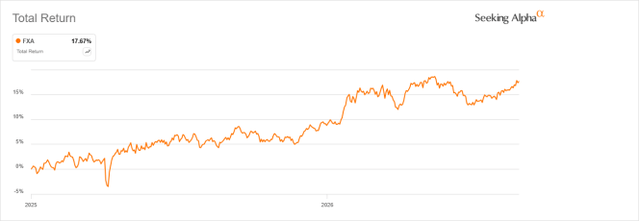
Since its inception in June 2006, FXA has gained 41.7%. However, it was not a steady trend, as plotted below.
FXA total return, 6/21/06 to 8/26/26 (Seeking Alpha)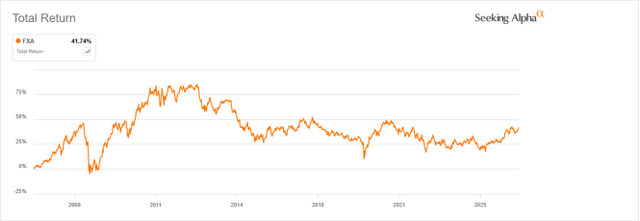
Distributions are directly tied to RBA rates and temporarily fell to zero when monetary measures were taken across the world in response to the pandemic crisis (2020-2022).
FXA distribution history (Seeking Alpha)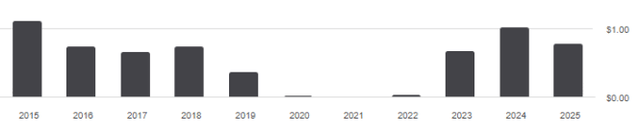
Alternatives
There is no other exchange-traded product tracking the AUD/USD pair listed in the US. However, alternatives exist:
- Holding AUD in a forex account or an Australian dollar bank deposit—the “DIY” method.
- CME Futures on AUD/USD.
FXA Drawbacks
- Currency risk is the primary risk driver. China-driven commodity demand and interest-rate differentials can reverse quickly.
- Physical AUD deposits in a single bank create significant counterparty risk related to JPMorgan Chase & Co. (JPM).
- Tax treatment as ordinary income is an inconvenience without capital risk.
- Limited liquidity warrants caution when placing a buy or sell order on FXA.
Use Cases
FXA may be used for tactical allocation in AUD by investors having a thesis based on the macro setups described above.
In theory, it may be used as a currency hedging instrument for AUD-denominated securities. For example, an investor may hold the same dollar value in a portfolio of stocks traded on the Australian Securities Exchange (“ASX”) and in a short position in FXA (in a margin account). If the stock portfolio gains 10% in AUD, the combination of both gains approximately 10% in USD, although discrepancies may appear depending on the rebalancing schedule. However, this hedging tactic relies on borrowing FXA shares and their continued availability, which may be problematic given the weak AUM.
Takeaway
FXA offers AUD/USD exposure in an exchange-traded product with a 0.40% expense ratio. FXA is best-suited for tactical allocation. Currency hedging is possible but not recommended.
- Pro: AUD/USD exposure in an ETP.
- Cons: high expense ratio, low liquidity and AUM, counterparty risk.
This article answers these three main questions about FXA:
- How is FXA structured?
- What macro setups can move the Australian dollar?
- What type of strategy is FXA best suited for?
Editor’s note: This article is intended to provide a general overview of the ETF for educational purposes only and, unlike other articles on Seeking Alpha, does not offer an investment opinion about the ETF.