






Dear Partners,
Our fund’s performance during the second quarter was largely unchanged from where your first-quarter statements ended, with Rowan Street declining approximately 1% during the quarter. That brings our net return for the first half of 2026 to -21%.
While the stock prices of many of our holdings have remained under pressure in 2026, the businesses themselves have continued to execute well. We’ve seen periods like this several times throughout Rowan Street’s 11-year history, where stock prices temporarily diverged from underlying business performance. They are a natural part of long-term investing, and we believe that, over time, business performance ultimately drives investment returns.
With that, let’s set the stock market aside for a moment.
Imagine you had been away for the past six months—with no internet, no financial news, and no way to check stock prices. If you owned these businesses privately, the only question worth asking upon your return would be:
How are the businesses we own actually performing?
Let’s answer that question. The following is the report we would want to receive as business owners.
Business Owner’s Report
Meta Platforms (META)
Business Update:
Meta delivered another exceptional first half of 2026. Revenue grew 33% year over year to $56.3 billion in the first quarter, followed by another 28% increase to $60.8 billion in the second quarter. First-half revenue reached approximately $117 billion, while trailing twelve-month revenue surpassed $228 billion, up 26% year over year. Meta’s Family of Apps now serves approximately 3.6 billion people each day.
Perhaps most encouraging, the company’s AI investments are already producing measurable results across engagement and advertising. Instagram time spent grew at a double-digit rate, while Facebook (META) video time increased 9%, driven largely by improvements in AI-powered recommendations. At the same time, ad impressions increased 14% and the average price per ad rose 12%, helping Family of Apps advertising revenue grow 27% during the second quarter.
Meta’s AI-powered advertising products are also scaling rapidly. Advantage+, its suite of automated campaign tools, has reached a $75 billion annual revenue run rate, while more than nine million small businesses now use at least one of Meta’s generative AI creative tools. Recent improvements to the company’s advertising models increased ad clicks by 8.3% and conversions by 15.7% on Facebook.
Market Narrative:
Despite another quarter of exceptional revenue growth, investor attention remained firmly fixed on the cost of Meta’s expanding AI ambitions. Capital expenditures reached $31 billion during the quarter, reducing free cash flow to less than $1 billion, while management raised the lower end of its expected 2026 capital expenditures to $130 billion.
The market’s concern is whether Meta’s AI infrastructure investments will ultimately earn attractive returns on the enormous amounts of capital being deployed. While AI is already producing measurable benefits across advertising and user engagement, investors remain uncertain about how large those benefits can ultimately become and how quickly emerging opportunities in AI agents, subscriptions, model APIs, and enterprise services will translate into meaningful earnings and cash flow.
Our Perspective:
Now let’s zoom out and evaluate the business as owners.
While investors continue to debate the long-term returns Meta will earn on its unprecedented AI infrastructure investments, we find it useful to step back and evaluate the business over a longer time horizon. Since we first invested in Meta back in 2018, the company’s annual revenue has increased from approximately $48 billion to more than $228 billion.
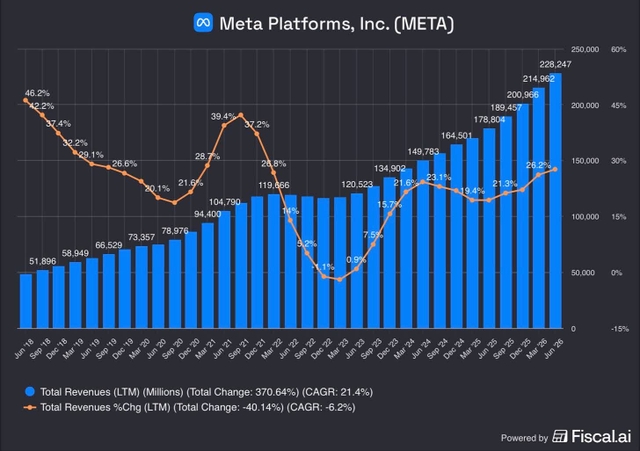
More remarkable than the increase in size is the durability of the business. After navigating Apple (AAPL)’s privacy changes, intensifying competition, the metaverse investment cycle, and now an unprecedented buildout of AI infrastructure, Meta managed to return to roughly the same rate of growth it achieved in 2019 despite now generating nearly 5x as much annual revenue. Think about it — a business serving approximately 3.6 billion people and generating more than $228 billion in annual revenue is still growing at nearly 30% per year.
No one can know today what return Meta will ultimately earn on its current AI infrastructure investments. However, the evidence so far is encouraging. Many of the improvements driving today’s business—higher engagement, better advertising performance, and new AI-powered products—are the direct result of Meta’s investments in artificial intelligence.
When outcomes are uncertain and the investment horizon stretches many years into the future, we believe it is often more important to evaluate these decisions in the context of management’s long-term capital allocation record. Mark Zuckerberg has repeatedly demonstrated a willingness to make large, unpopular investments years before their economic benefits became widely recognized. That history does not guarantee success this time, and some investments—most notably Reality Labs—have yet to demonstrate attractive economic returns. Nevertheless, his record as a founder, business builder, and capital allocator gives us confidence that these decisions reflect a thoughtful capital allocation process informed by far deeper insights into the business than we, or the market, can reasonably have.
Overall, our conviction in Meta has only increased since we first invested in 2018. Although Meta’s share price has appreciated substantially over that time, the underlying business has improved even more. In our view, Meta is a stronger business today, with wider competitive advantages and greater long-term earnings power than when we first became owners.
For readers interested in a more detailed discussion of how our Meta thesis has evolved, we recently published a separate essay: Why We Like Meta More Today Than When We First Bought It.
Tesla (TSLA)
Business Update:
Tesla continued to make progress on what we believe are the initiatives that matter most over the long term. The company achieved record Q2 deliveries, exited the quarter with its largest order backlog since 2023, and management noted that production is increasingly constrained by supply rather than demand.
Perhaps most notably, Full Self-Driving (FSD) is becoming a primary driver of customer demand. As Musk remarked, many customers are now “buying Full Self-Driving with a car attached” rather than simply purchasing a vehicle. Robotaxi operations also continued to scale during the quarter. Tesla expanded service to seven U.S. markets, including Texas, Florida, and the San Francisco Bay Area, with autonomous miles driven increasing by more than 10% each week. Management emphasized that the pace of expansion is being dictated not by demand, but by safety. Optimus also remains on track to begin production, although management emphasized that manufacturing will likely scale gradually given the unprecedented complexity of building what Elon Musk believes could ultimately become the largest product in history.
Tesla also continued investing aggressively in the infrastructure supporting its long-term roadmap. Management expects capital expenditures to exceed $25 billion this year and continue increasing over the next several years as the company expands Robotaxi, Optimus, AI compute, semiconductor manufacturing, energy storage, and vehicle production capacity.
Market Narrative:
The market remains focused on the length of Tesla’s investment cycle. Management now expects capital expenditures to continue increasing over the next several years as the company builds out Robotaxi, Optimus, AI infrastructure, and semiconductor manufacturing. Investors are questioning how long profitability and free cash flow will remain under pressure before these investments begin generating meaningful returns.
Our Perspective:
Our investment thesis remains unchanged since we first became owners a little over a year ago. We continue to believe the market is largely focused on the visible costs of Tesla’s current investment cycle, while placing less value on the interconnected ecosystem the company is building beneath the surface. Tesla’s advantage is not one isolated technology or product, but a collection of reinforcing capabilities—including manufacturing, real-world data, artificial intelligence, software, energy, and vertical integration—that we believe continuously reinforce one another, making the overall system increasingly difficult to replicate.
For readers interested in a deeper discussion of our investment thesis, we recently published Tesla’s Invisible Moat: The Most Elegant Physical AI Training Program Ever Built, where we explore why Tesla’s moat is deeper than the market may appreciate—and why we believe competitors will find it exceptionally difficult to replicate.
Shopify (SHOP)
Business Update:
Shopify reports its Q2 results on August 5, so this update reflects the company’s Q1 performance. Shopify delivered another outstanding quarter. Revenue grew 34% year over year to $3.2 billion—its strongest quarterly growth in four years—while Gross Merchandise Volume (GMV) increased 35% to $101 billion, marking the second consecutive quarter above the $100 billion threshold.
Growth remained broad-based across the platform. B2B revenue increased 80%, Shop Pay revenue grew 59%, free cash flow margin remained a healthy 15%, and core operating income more than doubled to $382 million.
Market Narrative:
The market remains focused on the potential impact of AI-powered shopping agents. As consumers increasingly use conversational AI to search for products and make purchases, some investors question whether traditional e-commerce platforms will remain as important in facilitating online commerce.
Our Perspective:
We came away from the quarter with the opposite conclusion. Rather than being disintermediated by AI, Shopify appears to be positioning itself as one of the foundational infrastructure providers for agentic commerce. Through initiatives such as the Universal Commerce Protocol, the company is helping establish an open standard that allows AI shopping agents to discover products, interact with merchants, and complete purchases using Shopify’s commerce infrastructure.
If AI increasingly becomes the interface through which consumers shop, we believe Shopify is working to ensure those transactions still flow through its platform rather than around it.
For us, the broader investment thesis remains unchanged. Shopify continues to evolve from an e-commerce platform into an increasingly comprehensive commerce operating system, providing merchants with more tools, more services, and deeper integration across their businesses. We believe AI will accelerate that evolution rather than disrupt it, making Shopify even more valuable to merchants over time.
Topicus (TOITF) (CVE: TOI)
Business Update:
Topicus reports its Q2 results on August 5, so this update reflects the company’s Q1 performance. Topicus delivered another solid quarter. Revenue grew 23% year over year to €435.7 million, while organic growth remained positive at 5%. Although reported net income declined 24%, the comparison is distorted by a one-time gain recognized in the prior year. Adjusting for that item, underlying earnings increased by approximately 42%.
The more important development over the past year has been capital allocation rather than quarterly earnings. Topicus built a ~25% ownership stake in Asseco Poland (ASOWF), its largest investment to date, investing approximately €413 million at an estimated valuation of roughly 8x EV/EBITA. Since then, Asseco’s shares have appreciated significantly and now trade closer to 20x EV/EBITA, suggesting Topicus acquired a well-run acquirer of vertical market software businesses at a substantial discount to today’s market value.
Market Narrative:
Despite continued business progress, Topicus shares remain well below their 2025 highs. The decline has been driven primarily by a broader de-rating across vertical market software, as investors weigh the potential impact of artificial intelligence on legacy software businesses. This pressure has been more acute for Topicus than for its parent, Constellation Software (CNSWF), reflecting its smaller scale, higher visibility to the Asseco Poland transaction, and greater sensitivity to sentiment in European software markets specifically.
Our Perspective:
We believe the market is placing greater emphasis on near-term uncertainty than on the qualities that have made businesses like Topicus successful for decades.
The company’s software is deeply embedded within mission-critical workflows across government, healthcare, financial services, and other specialized industries where switching costs remain exceptionally high. While artificial intelligence will undoubtedly reshape software over time, we believe these businesses are better positioned than the market currently assumes. Management has openly acknowledged AI as an important technological development to monitor, which we view as a sign of disciplined leadership rather than complacency.
Perhaps more importantly, the Asseco investment illustrates exactly why we own Topicus. This was a large, patient allocation of capital into a high-quality business trading at a depressed valuation—an investment that has already created meaningful value. In our view, capital allocation of this quality remains one of Topicus’ greatest competitive advantages.
Constellation Software (TSE: CSU)
Business Update:
We initiated our Constellation Software position during the first quarter of 2026, building on the experience we’ve gained over the past four years as shareholders of Topicus, a Constellation spin-off we have owned since 2021.
Constellation is one of the most remarkable businesses we have ever studied. Since going public in 2006, it has compounded shareholder capital at approximately 28% annually while growing revenue at roughly 23% per year and operating profit at nearly 29% per year.
Operationally, the business continues to execute well. First-quarter revenue increased 20%, while free cash flow available to shareholders grew 44%. During the quarter, Constellation deployed a record $766 million into acquisitions and has committed another $786 million since quarter-end, continuing the disciplined capital allocation that has defined the business for decades.
Market Narrative:
The market’s concerns appear centered on two issues. First, the same questions surrounding artificial intelligence that have weighed on Topicus and the broader vertical market software sector. Second, founder Mark Leonard’s decision to step down as President for health reasons in late 2025, creating understandable uncertainty around the future leadership of one of the world’s most respected capital allocators.
Our Perspective:
Our view differs from the market on both issues.
On artificial intelligence, we believe the market is underestimating the durability of Constellation’s businesses. Much of its software sits at the center of mission-critical operations within governments, healthcare systems, utilities, education, financial services, and other specialized industries. These are not applications that can simply be replaced by a better AI model. The switching costs are operational, organizational, and deeply embedded within customers’ daily workflows.
On leadership, we believe one of Mark Leonard’s greatest accomplishments was designing Constellation so that it would not depend on him. The company’s decentralized operating model, capital allocation framework, and culture have been built deliberately over decades. Mark Miller, who has been with the company since its first acquisition in 1995, has stated that neither the strategy nor the operating philosophy is changing.
We wish Mark Leonard the very best in his recovery. We also believe the enduring value of Constellation lies not in one individual, but in the decentralized system he spent decades building. In many ways, creating a business capable of thriving beyond its founder may be one of his greatest achievements.
For readers interested in a more detailed discussion of these issues, we recently published a separate essay: Our Investment in Constellation Software Amid Elevated Uncertainty.
Why Haven’t the Stocks Followed?
After reviewing each of our businesses, a natural question remains. If these companies continue to execute so well, why haven’t many of their stock prices followed?
We believe the answer has less to do with how our businesses have performed over the past six months than with where the market’s attention has been concentrated during that same period. While our companies continued to strengthen their competitive positions, investors directed much of their enthusiasm elsewhere.
Much of this year’s market leadership has come from companies supplying the physical infrastructure behind artificial intelligence. Memory manufacturers, semiconductor companies, and other businesses enabling the AI buildout have produced extraordinary returns as investors have poured capital into the sector. At the same time, many companies actually deploying AI into products used by customers every day—including several we own—have seen far less recognition despite continued operational progress.
The enthusiasm behind this investment cycle is understandable. OpenAI (OPENAI) and Anthropic (ANTHRO) have grown at rates with almost no precedent in enterprise software history, leading Amazon (AMZN), Microsoft (MSFT), Alphabet (GOOGL), and Meta to collectively commit an estimated $700 billion toward AI infrastructure during 2026 alone. Artificial intelligence is clearly one of the most important technological shifts of our generation and has the potential to become one of the most consequential technological transformations in human history.
The investment question, however, is different from the technology question.
Today’s market prices increasingly assume that today’s extraordinary growth rates will continue for many years. That assumption may ultimately prove correct. It may not. We simply don’t know. What we do know is that when expectations become exceptionally high, the margin for error becomes exceptionally small.
We don’t know when—or whether—that concentration unwinds. Making that kind of prediction isn’t part of our investment process, and it never has been. History reminds us that periods of extraordinary enthusiasm come and go. Our response has never been to predict when they will end, but simply to remain disciplined while they unfold.
Instead, we continue to evaluate businesses one at a time. The portfolio that has emerged from this process looks different from where the market’s enthusiasm has concentrated this year. Meta and Tesla are participating directly in the AI transformation, but we own them for the same reasons we own every Rowan Street investment: exceptional businesses with durable competitive advantages, outstanding management, and long runways to reinvest capital at attractive rates. Their participation in AI reinforces our investment thesis—it is not the investment thesis.Shopify, Topicus, and Constellation currently face near-term uncertainty from the same narrative, but we believe each is considerably better positioned to benefit from AI than the market gives them credit for.
Rather than chasing that momentum, we remain comfortable owning businesses we understand, whose operating performance continues to improve, even if the market chooses—for now—to reward something else.
Over time, we believe business performance and stock performance tend to converge. Our job isn’t to predict when that convergence will occur. Our job is simply to continue owning exceptional businesses that become more valuable over time.
As always, we remain deeply grateful for the trust our partners have placed in us. We continue to have the substantial majority of our own net worth invested alongside yours. That reflects our conviction — not just in the businesses we own today, but in the investment philosophy and decision-making framework we have spent more than a decade refining.
Best regards,
Alex and Joe
Original Post
Editor’s Note: The summary bullets for this article were chosen by Seeking Alpha editors.