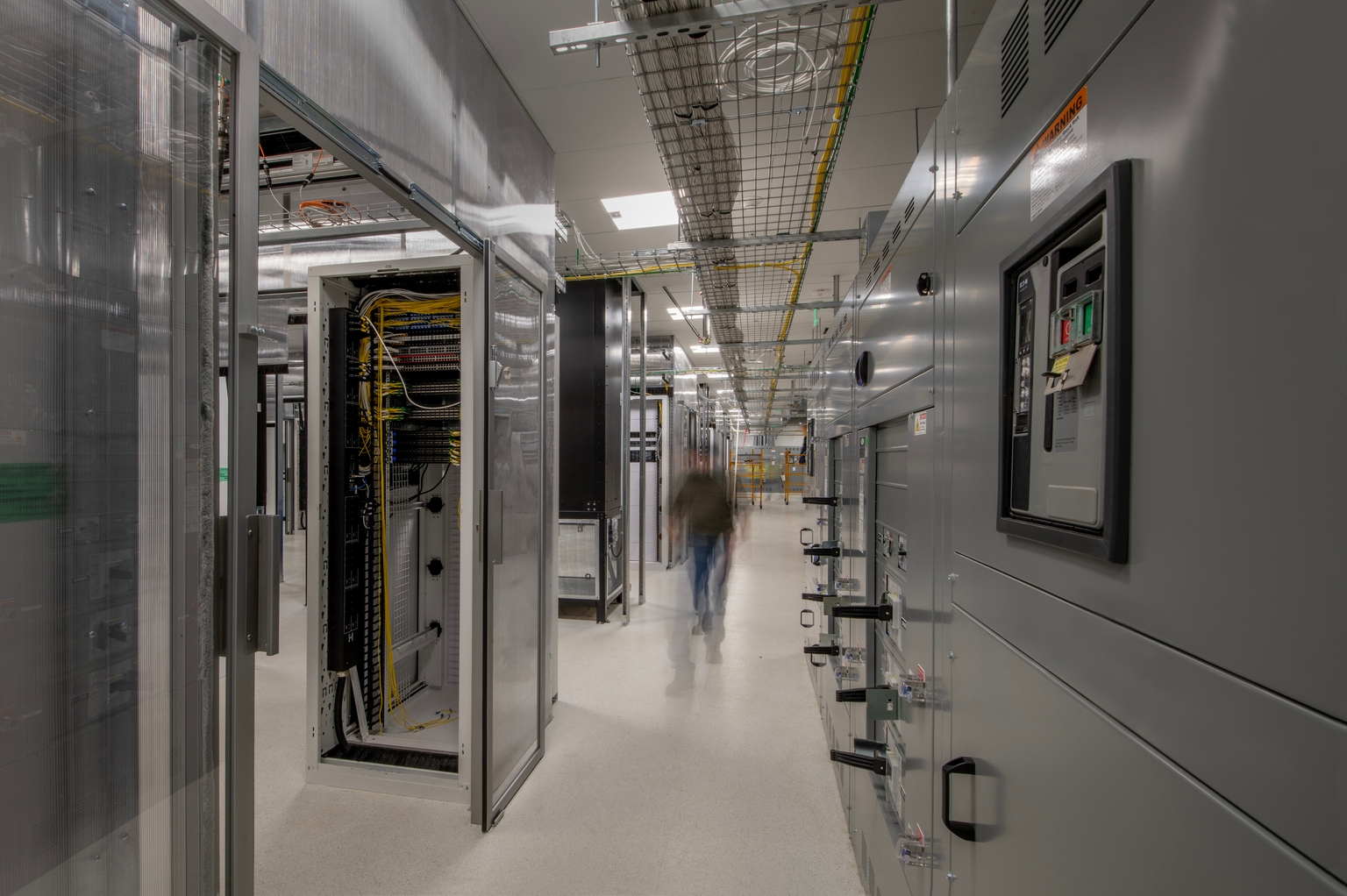








Introduction to the Global X Data Center & Digital Infrastructure ETF
The Global X Data Center & Digital Infrastructure ETF (DTCR), which was launched on October 27, 2020, has so far managed to garner total assets under management (AUM) of over $1.2B. DTCR, which is backed by Global X Management Company LLC (which in turn is owned by the Korean-based asset management business Mirae Asset Global Investments Co., Ltd.), is priced at an expense ratio of 0.5% and pays dividends twice a year (these semi-annual distributions annualize to a figure of less than 1% at the current ETF price).
What Does DTCR Do, And How Is It Built?
DTCR’s purpose is to offer investors exposure to a basket of 25 global stocks whose businesses are oriented around the operation of data centers, cellular towers, and other digital infrastructure hardware. Note that DTCR doesn’t randomly pick stocks of this ilk but rather passively follows an index called the Solactive Data Center REITs & Digital Infrastructure Index (SDCRDII).
SDCRDII, which is crafted and maintained by a German-based index provider called Solactive, employs quite an elaborate stock selection process before narrowing down its portfolio.
The initial purpose of this index is to source a portfolio of global businesses that derive at least half their revenue, operating income, and asset base from one or all of three business activities. Interestingly, besides developed market stocks, this index only fishes for EM stocks from China, Indonesia, South Korea, and Taiwan. The three business lines are:
- Ownership, operation, and development of data centers,
- Ownership, operation, and development of cellular towers,
- Design, manufacture, and assembly of servers and hardware related to data centers and cellular towers.
To ascertain this, the index providers utilize a natural language processing algorithm that scours public news, filings, and earnings reports and then assigns ranks.
In the next stage, all data centers and cellular tower stocks are added as long as there are 40 stocks; if there are fewer than 25 stocks, then the third category of stocks of digital infrastructure hardware is also considered until they arrive at 25 stocks.
During the weighting process, data center and cellular tower stocks are permitted a maximum individual weight of 12%, whereas the weight of digital hardware stocks is lower at 2%. Also, all stocks with individual weights of over 4.5% are not allowed to jointly aggregate to 45% of the entire portfolio. All these weighting adjustments take place twice a year (the end of January and July).
What Are The Main Features Of DTCR’s Portfolio?
While DTCR is supposed to be a portfolio of stocks from around the world, it’s worth noting that almost 75% of the portfolio comes from the US alone.
Global X
Admittedly, this is not some deliberate ploy by DTCR to focus on US stocks alone, but rather the reality of these focus markets is that they are largely based in the US. For instance, it is believed that over half the data centers around the world are based in the US alone.
Global X
With regard to traditional sector classifications (or the standard benchmark, which is the Global Industry Classification Standards), this portfolio can be broken up into three sectors (real estate, technology, and communication services), with the first sector taking the cake, with a weight of 60% alone.
Global X
If one wants to get more granular, one could also look at DTCR from certain industry sub-types; here, we can see that one gets exposure to six different industries, but Equity REITs account for the lion’s share at nearly 59% (this is not a surprise when one considers that DTCR’s tracking index resorts to looser caps of 12% on data center companies or cellular tower companies, most of which are structured as REITs)
Global X
From a market-cap breakup angle, since DTCR’s tracking index has imposed a minimum market-cap threshold of $200M, one can expect a good chunk of micro-caps to be weeded out from this portfolio; indeed, micro-cap exposure is quite minimal at only 3%, with mid-caps accounting for the largest chunk (42% of the portfolio).

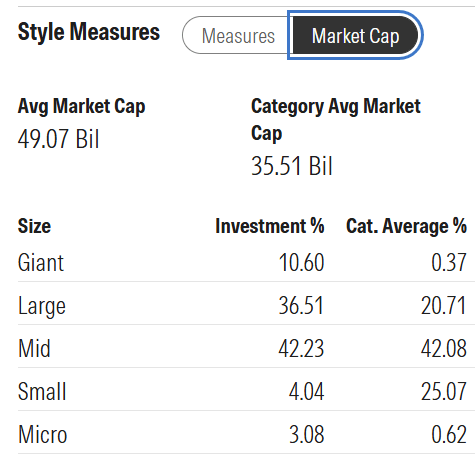
Morningstar
Stylistically, DTCR spreads its tentacles across value, growth, and even hybrid stocks (those with both growth and value characteristics, such as relatively cheap valuations but strong sales/earnings growth potential), with mid-cap hybrids accounting for the largest share.

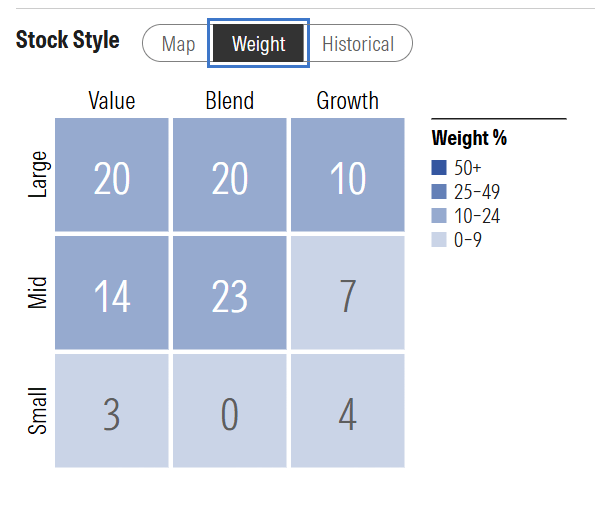
Morningstar
What Are the Risks Associated With DTCR?
The degree of variation of DTCR’s price movements within a year doesn’t make it suitable for investors with low-risk appetites. Note that its annualized standard deviation of over 23% is over 600 bps higher than the median ETF level.
Seeking Alpha
Then, even though DTCR resorts to some capping policies, it is not enough to shake off the degree of concentration in its top holdings, making this product vulnerable to the prospects of just a handful of stocks. For most ETFs, the top 10 exposures amount to less than 50%, but in DTCR’s case, the top 10 account for 72% of the portfolio, with just three stocks in particular- Digital Realty Trust, Inc. (DLR), Equinix, Inc. (EQIX), and American Tower Corporation (AMT)—taking up over 36% of the portfolio.

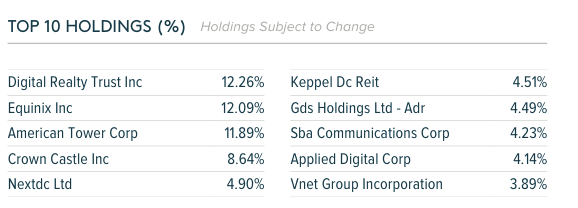
Global X
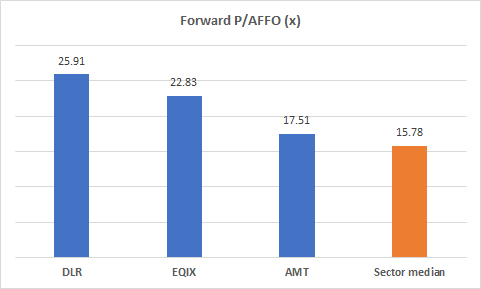
This top three concentration risk takes on an even more pronounced hue when these stocks are not particularly cheap. This is a scenario we are in at the time of this writing, with DLR and EQIX priced at price-to-adjusted funds from operations (P/AFFO) multiples that equate to a premium of 44-64% over the sector median multiple of less than 16x.

Seeking Alpha
Ongoing power challenges in the US could also make it difficult for these developers to adroitly ramp up the volume of data center space they could make available. Forecast studies have shown that the electricity consumption requirements of these data centers may not be met given the competing requirements from semiconductor manufacturing and electric vehicles.
Global X
Given that an overwhelming chunk of this portfolio consists of equity REITs that are typically noted for facilitating high payouts, some investors may be tempted to believe that DTCR could prove to be a very lucrative income proxy. However, the reality is quite different, as DTCR’s dividends have not grown over the last year or the last three years, and this ETF’s 0.9% yield equates to only one-third of what ETFs in general pay (2.7%).
Seeking Alpha
Who Is DTCR ETF For?
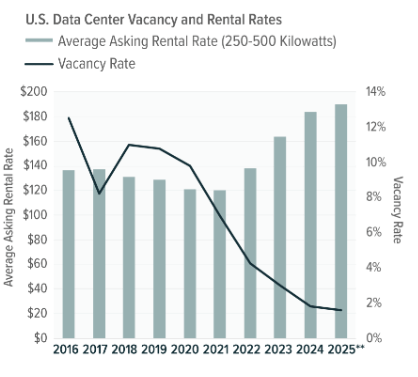
We view DTCR as suitable for those who like concentrated (it covers only 25 stocks with a strong top heaviness) and thematic bets in the form of a reasonably priced ETF (an expense ratio of 0.5%, which is in line with the median ETF rate); for instance, rather than focusing on which business is developing the best LLMs (Large language models) or which software company is best positioned to weather the AI storm, DTCR could be seen as an indirect and diversified route to profit from the Artificial Intelligence inference super cycle (over the next couple of years, AI inferencing is expected to double and account for the largest chunk of data center demand in GW terms) which is expected to keep a lid on already low vacancy rates and potentially translate to lucrative rental rates for its operators (which DTCR covers).

Global X
DTCR’s main focus around mid-caps also means that it would serve as a useful diversifier for large-cap-dominated portfolios. Meanwhile, it also largely stays away from the riskiest section of the market—micro-caps (given the $200M minimum market-cap requirement that prospective constituents need to fulfill).
While DTCR is largely US-based, it would also appeal to those who prefer ETFs that offer some degree of global exposure (over 25% of the total portfolio comes from abroad); most alternatives in this space focus only on US stocks.
Which Are the ETF Alternatives To DTCR?
Besides DTCR, investors may also consider other cheaper, older, but less popular passively managed alternatives such as the iShares U.S. Digital Infrastructure and Real Estate ETF (IDGT) or the Pacer Data & Infrastructure Real Estate ETF (SRVR).
The former tracks an index called the S&P Data Center, Tower REIT, and Communications Equipment Index, while the latter follows a more strategy-driven index called the ” Solactive GPR Data & Infrastructure Real Estate Index.
Both these alternatives offer slightly more coverage, especially SRVR, but it appears that all three have high concentration in their top 10 stocks. The high turnover ratios of both these alternatives suggest that they incur considerably more transaction costs, but also consider that they offer better yields (both these peers also pay more frequently than DTCR). SRVR, like DTCR, is tilted mainly to the real estate sector (IDGT tilts more towards tech stocks), while IDGT, like DTCR, is tilted mainly to mid-caps (SRVR is oriented to large-caps).
Seeking Alpha, Morningstar
Summary
DTCR, which passively tracks an elaborately constructed index, focuses on 25 global stocks (although with a strong US tilt) that derive half their business from the operation of data centers, cellular towers, and other digital infrastructure hardware. For an ETF that tilts towards REITs, DTCR’s income profile could be better, while its concentration on some highly valued REITs should be monitored.
This article answers these three main questions about DTCR:
- What are the notable characteristics of the DTCR portfolio, and how is it constructed?
- What type of investor is DTCR suitable for, and what are the risks associated with it?
- How does DTCR compare to its peers?
Editor’s note: This article is intended to provide a general overview of the ETF for educational purposes only and, unlike other articles on Seeking Alpha, does not offer an investment opinion about the ETF.