








The Sell Thesis
Blackstone Digital Infrastructure Trust (BXDC) is positioned to deliver a reliable yet disappointing return to shareholders. Our analysis suggests that even if everything goes according to plan, total shareholder return is likely below market.
The problems are structural in nature with high upfront and ongoing expenses weighing on what would already be a mediocre cash flow. Let’s get into it
Blank Check is a Bad Structure for a REIT
BXDC is effectively a blank check company in that they had no assets at the time of IPO, and their assets now consist of the proceeds raised in the IPO.
Blank check companies are inherently inefficient because a significant portion of proceeds are eaten up by fees before the capital ever gets invested.
BXDC issued 87.5 million shares and a 13.119 million share greenshoe for total proceeds of $2.012B as detailed in their 10-Q.
BXDC
However, offerings are expensive. Underwriting and fees ate up fully 5% of the proceeds as per the 10-Q:
“After giving effect to underwriting discounts and commissions and estimated offering expenses payable by us, we had approximately $1.9 billion of net proceeds available to execute our business strategy.”
So the $2B+ raised is already down to $1.9B.
This is not a BXDC-specific problem, as underwriting costs would be in that ballpark for most offerings.
The challenge of a blank check company is that there are no going-in assets or businesses to offset the costs. So it becomes blindingly apparent that each dollar invested has become 95 cents.
Blank check companies can offset this problem by having a really good idea with extreme return potential. Thus, you will see the most blank check company success in innovative areas of the market where the delta between a good idea and a bad idea trumps the delta between $1.00 and $0.95.
Consider the 95 cents applied to a biotech company with a drug that is about to pass FDA trials. When done well, that 95 cents can easily become far more than a dollar.
REITs are more of a financing area of the market. Performance is heavily driven by a low cost of capital and clean, cost-effective operations. Starting from a point of already being down 5% is a tough sell.
We will illustrate the difficulty of overcoming the expensive structure of a blank check company by simply doing basic arithmetic on the plans as laid out by BXDC.
Math Looks Disappointing at Best
As laid out in the previous section, a blank check company needs to have some key innovative idea that makes the high-cost structure worth it.
BXDC’s idea is about as generic as it gets.
Nicholas Pell (CEO) describes their strategy on the 2Q26 earnings call:
“BXDC is a REIT focused on acquiring stabilized mission-critical data centers that power the modern digital economy.”
He went on to specify:
“Recently built high-quality income-producing data centers located in Tier 1 markets with long-term leases to top investment-grade hyperscalers, no development risk, no power or entitlement risk and powerful downside protection with assets fully leased at the time of acquisition to some of the most creditworthy tenants in the world.”
So basically, state-of-the-art, newly built data centers leased to Amazon, Microsoft, or Google. Those are very strong assets, but it doesn’t take much insight to know these are strong assets.
Everyone knows these are strong assets, and capital is already chasing such assets. This shows up in the cap rates. On the 2Q26 call, Pell discussed cap rates:
“We remain confident in our ability to deploy capital at attractive yields with close to $30 billion of recent comparable transactions in the market pricing at the low to mid-6 cap rates.”
So it looks like cap rates will average about 6.2%. The company is targeting 40% leverage per the commentary of Anthony Francis Marone, BXDC’s CFO:
“We currently have no debt on our balance sheet, but expect to target 40% leverage over time as we prudently access asset-level and corporate debt to finance new investments.”
I estimate cost of debt would be about 5.5%.
While this is a Blackstone (BX) company, they do not have the same credit as BX. The credit rating of BXDC is that of a small-cap REIT soon to have 40% leverage.
With these numbers in mind, we can run the math.
Assuming a 6.2% cap rate and 5.5% cost of debt, there is a 70 basis point spread, so the use of 40% leverage would add 28 basis points (70 X 40%) of incremental ROE. Thus, ROE looks to be about 6.48%
2MC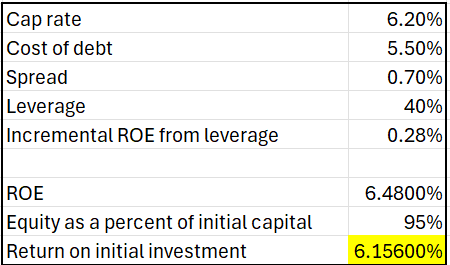

However, only 95 cents of each initial dollar will get invested, as 5% was lost to IPO fees.
So, the return to the IPO investors looks more like 6.156%.
This is the before-expenses figure. There is a management fee of 1% of market cap and an incentive fee of 0.25% of market cap.
Per the 10-Q:
“The Management Fee will be measured and paid quarterly in arrears (subject to pro-rating for partial periods) and will equal (i) 1.00% per annum of our Market Capitalization (up to a total Market Capitalization of $25.0 billion);”
These overhead costs bring return to IPO investors down to 4.9% or 5.156% if the incentive fee is not earned.
2MC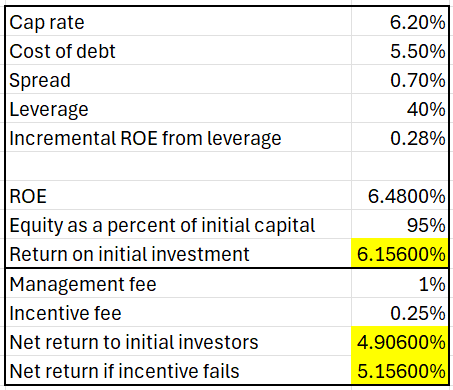

Return to new investors is just as bad since the stock is trading slightly above the $20 IPO price.
SA
A 5% fundamental return is a rather dismal return for an equity investor.
It gets even worse when we consider adverse scenarios. The math above was with the following assumptions:
- Every lease is paid.
- Occupancy is 100%.
- Capital is fully allocated in a timely manner.
Long-term leases to hyperscaler counterparties make the first 2 bullet points quite likely, but the 3rd could be a real drain on returns.
Capital deployment can take a while, and starting in November (when management fees commence), that 1% management fee is going to take a bite out of returns. If capital is deployed too slowly, they might be investing 94% or 93% of IPO proceeds instead of 95%.
There is also some risk on the cap rate front. BXDC is on a clock to put the capital to work quickly, and the assets they are going after are highly sought after. Competitive bidding processes could easily take cap rates lower.
I just don’t see the upside here. The long-term net lease nature of their targeted investments really caps the upside. No matter how bullish you are on data centers, that contractual-style revenue doesn’t budge.
Net lease investing is all about value and efficiency. Investing in fixed-return-style assets in a highly inefficient manner, like a blank check company, is a recipe for dismal returns.
Every Scenario is a Winning Scenario for Blackstone
While I view BXDC as a poor investment for shareholders, it is yet another win for the parent company. BX profited on the IPO and continues to profit on management fees. Blackstone has been and remains one of the most skilled companies at raising AUM.
If you like the Blackstone brand, you might be better off buying BX over BXDC
If you like data centers, consider buying Equinix (EQIX) instead. EQIX is an incredibly well-managed company that creates value through its operating expertise and ecosystem model.
